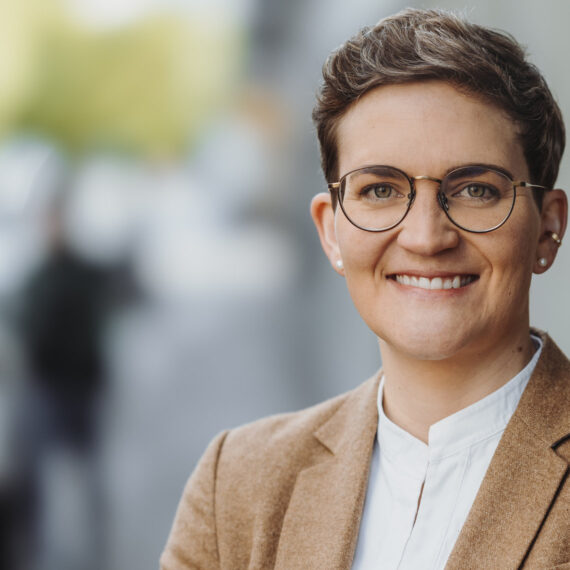

AI agents plan tasks and carry out actions independently. Anne-Sophie Morand, Data & AI Governance Counsel at Swisscom, explains how this is changing the requirements for AI governance and how good governance can promote collaboration between people and AI.
White paper
If you would like to gain a deeper understanding of how agent AI works, which security, governance and data protection aspects need to be considered and how companies can plan their productive use, it’s worth taking a look at the white paper ‘From generative to agent AI’.
Anne-Sophie Morand, when we spoke to you about AI governance in 2024, the main focus was on generative AI applications. Today, there is increasing discussion about AI agents. What new requirements or consequences will this entail for companies’ AI governance?
Developments over the past few years have impressively demonstrated how rapidly the potential applications of artificial intelligence are changing. While the main focus in 2024 was on generative AI applications such as chatbots, companies are increasingly engaging with AI agents who can also independently plan tasks, access corporate systems and carry out actions within certain limits. This also shifts the focus of AI governance: Issues of autonomy, access rights, human control and responsibilities are becoming increasingly important. At the same time, companies must continuously adapt their AI governance to technological developments. AI governance is therefore not a one-off project, but an ongoing process.
‘AI governance is not a one-off project, but an ongoing process.’
Anne-Sophie Morand, Data & AI Governance Counsel, Swisscom
I would even go a step further and speak of the development of AI governance towards AI change governance. With the increasing integration of AI into business processes, it is no longer just a question of controlling technology and its risks, but also of supporting fundamental organisational change. Companies need to grapple with how people and AI will work together in the future, how tasks and responsibilities will change, and which new skills will be required. Good AI governance must enable and accompany this change.
Significant differences between data governance and AI governance
Data governance governs and controls the handling of data.
AI governance goes further than that: It creates the control framework for the development and operation of AI systems and for the development and provision of AI models for general use (GPAI models). This includes in particular the purposes for which AI may be used, the legal, ethical and operational risks associated with it, who bears responsibility and the requirements in terms of transparency, security, human supervision and control that must be met.
Data governance and AI governance are therefore closely intertwined. Functioning data governance forms an important basis for good AI governance, but cannot replace it.
What makes an AI agent different from a traditional AI assistant?
So far, there is no universal definition of what exactly is meant by an AI agent. The EU’s AI Regulation, for example, also does not contain an independent legal definition. In my personal understanding, however, the distinction between a classic AI assistant and an AI agent can be made as follows:
A traditional AI assistant usually responds to specific requests and provides, for example, a text proposal or a summary. The next steps are basically determined by the person. However, many wizards already have agent functions such as code execution or access to connected applications, are used less restricted and should not be underestimated in terms of their criticality. An AI agent goes beyond that. They can pursue a given objective, independently plan the necessary intermediate steps, access data and applications and carry out actions. They can independently determine which steps are required to achieve an objective and adapt their approach accordingly.
‘Instead of simply describing a system as agents or non-agents, I think it makes more sense to ask how pronounced its agentic abilities are and what degree of autonomy it has.’
Anne-Sophie Morand, Data & AI Governance Counsel, Swisscom
However, the boundaries between AI assistants and AI agents are blurred. Rather than simply calling a system agents or non-agents, I think it makes more sense to ask how pronounced its agent capabilities are and what degree of autonomy it has.
Is an AI agent also an AI system from a legal point of view?
As a rule, an AI agent will meet the defining characteristics of an AI system within the meaning of the EU AI Regulation. Which regulatory requirements apply depends in particular on the specific purpose and the respective role of the actors involved. It is also important that AI agents, despite their potentially far-reaching autonomy, are not independent legal entities. Legal responsibility shall remain with the natural or legal persons responsible under the applicable regulations.
What new or increased risks are created by AI agents?
We are already familiar with many risks from traditional AI systems. In the case of AI agents, however, they can increase considerably, because they not only generate content, but can also trigger independent actions.
A simple example: If an AI assistant incorrectly evaluates a customer request, an employee can identify the error before taking any further steps. An AI agent could already initiate an unauthorised refund or change customer data based on the same incorrect assessment, provided they have the corresponding authorisations.
‘Despite their autonomy, AI agents are not independent legal entities. The legal responsibility lies with natural or legal persons.’
Anne-Sophie Morand, Data & AI Governance Counsel, Swisscom
It becomes particularly challenging when AI agents not only carry out individual actions independently, but can also determine how to achieve a specified goal. This means that it is no longer possible to determine or predict all steps in advance. In addition, there are additional security risks, such as manipulated information that can cause an AI agent to take undesirable actions, or improper system access.
And how does the risk picture change when not just an agent but a so-called multi-agent system is used?
In multi-agent systems, additional risks arise from the interaction and mutual dependencies of the individual AI agents. For example, one agent can build on the erroneous results of another, causing errors to spread over several work steps and, in the worst case, trigger chain reactions. Conflicting actions or manipulated information shared between agents can also be problematic. At the same time, it can become more difficult to understand individual decisions and actions.
For AI governance, this means that it is not enough to look at each AI agent in isolation. Rather, the interaction of the agents and thus the overall system must also be assessed and controlled. In particular, companies need to define the roles and privileges of each agent, how they communicate with each other and what information they are allowed to exchange. Equally important are clear responsibilities, the traceability of the entire chain of action and suitable control mechanisms, such as human approvals for critical actions and continuous monitoring.
White paper: from GenAI to agent AI
If you’d like to gain a deeper understanding of how agent AI works technically, what security, governance and data protection aspects need to be taken into account and how companies can plan their productive use, it’s worth taking a look at the white paper ‘From generative to agent AI’.
Switzerland does not have an AI law modelled on the EU AI Act. Why should Swiss companies nevertheless address AI governance, and how could regulation develop in the future?
Companies already have to comply with numerous existing legal provisions when using AI, in particular data protection law, privacy and confidentiality protection, contract law and intellectual property law, as well as sector-specific regulations where applicable. In addition, due to its extraterritorial effect, the EU’s AI Regulation can also be directly applicable to Swiss companies under certain conditions.
At the same time, Switzerland is working on its own AI regulation. At the end of March 2025, it signed the Council of Europe’s AI Convention, whose implementation into Swiss law is currently being prepared by the Federal Office of Justice. According to the current schedule, a consultation proposal should be available in spring 2027.
If you want to know what regulatory requirements we might face in the future, you don’t have to look far. I recommend taking a look at the Council of Europe’s AI Convention and the accompanying explanatory report. The convention formulates principles that are relevant beyond individual industries. These include, for example, transparency and human oversight, protection against discrimination and risk management. In my view, this argues in favour of regulating fundamental requirements for AI in Switzerland across departments and only supplementing them with sector-specific regulations if necessary.
AI governance established early on enables companies to proactively prepare for future regulatory requirements. If you already have functioning governance structures in place today, you will be able to adapt them to new legal requirements instead of having to start from scratch again later.
Swisscom has been using a risk-based approach for several years. Which findings have proved to be particularly important?
One important finding is that our risk-based approach has been very successful. Numerous AI systems have now gone through our governance process. This shows that more than 95 percent of the AI systems we develop or operate can be assigned to our two lower risk categories (minimal risk and low risk). Only a handful are actually considered high-risk AI systems.
Second, the fact that we orientate ourselves to the EU AI regulation for risk classification, but consciously supplemented these with our own risk criteria for the high-risk category has proven particularly successful. Even AI systems that are not classified as high-risk AI systems under the EU AI Regulation can entail significant risks from a company’s perspective, for example to the company’s reputation. In doing so, we take our entrepreneurial responsibility seriously and at the same time retain the necessary flexibility to respond to new technological developments and potential applications.
In your opinion, what are the most important recommendations for companies that want to rebuild AI governance or further develop their existing governance?
There are numerous recommendations for establishing functioning AI governance. If I had to confine myself to three particularly important points, they would be the following:
Firstly, Create transparency and clarify responsibilities. Companies should first know where and why AI is actually being used or developed. It is crucial that clear responsibilities are defined for each AI system and, where relevant, also for GPAI models.
Secondly, Risk-based approach. Not every AI system requires the same specifications and controls. Companies should assess their AI systems on the basis of comprehensible criteria, taking into account their intended use and risk potential. Appropriate requirements for development and operation can be derived from this.
Thirdly, Understand AI governance as an ongoing process. Technological development is too dynamic for rigid rules. Companies should therefore take a pragmatic approach, use existing structures and processes and gradually build up or further develop their AI governance. New developments such as AI agents show how important it is to regularly question and adapt existing governance requirements and control mechanisms.
Ultimately, good AI governance should not be seen as a bureaucratic hurdle, but as the basis for innovation. It creates the necessary framework for companies to take advantage of the opportunities offered by artificial intelligence without losing sight of the associated risks.
About Anne-Sophie Morand
Dr Anne-Sophie Morand, LL.M., is a lawyer and has been Data & AI Governance Counsel at Swisscom since 2023, where she leads the development and implementation of company-wide AI governance. Her focus is on data protection and the interface between AI and law. Prior to that, she worked for the Swiss Parliament, the FDPIC and a corporate law firm, amongst others. In February 2027, she will become Professor of Digital Transformation and Artificial Intelligence Law at the ZHAW School of Management and Law.