

Data has always been critical to business, but artificial intelligence is turning data quality into a key success factor. Incomplete, outdated or contradictory information reduces the usefulness, trust and scalability of AI applications.
Where do Swiss companies stand with data and AI?
Computerworld’s Swiss IT Study 2026 lays bare the tensions in the Swiss market: 57.1% of companies are already using AI productively in individual areas while 32.1% cite data quality as the biggest barrier to AI use cases. Many companies are no longer in the experimental phase – the challenge lies in scaling, reliability and the implementation of data governance and AI governance.
This is also reflected in the benefits and risks of AI. According to the latest Swiss IT Study, 33.9% expect AI to primarily increase efficiency, while 32.4% see wrong decisions as the greatest risk. The fact that only around a quarter of companies rate their own data quality for AI applications as good or very good, and the majority as mediocre or insufficient, underscores the need for action. Companies need to ask themselves: is my data foundation robust enough to use AI securely and effectively?
Why does AI need good data?
Artificial intelligence doesn’t work like traditional software or simple data queries. It not only processes information according to fixed rules, it also uses algorithms to identify patterns and correlations or to generate new content (GenAI). If the underlying data is incomplete, outdated, contradictory or biased, AI will reproduce these errors in its processing.
This results in imprecise models, flawed prioritisation and decision-making bases, unreliable forecasts, and incorrect results from automated processes. ‘Models are only as good as the data on which they are based,’ say the authors of the study OT Security in Transition, PAC, 2025/26.
AI doesn’t just scale findings, it also scales errors. Conversely, this means good data makes AI more secure and significantly increases its business value and trust in applications – a conclusion shared by the Swiss AI Playbook 2026 (1st edition).
This correlation is more difficult to recognise with generative AI. This is because GenAI formulates answers, summaries, recommendations and entire texts that are linguistically convincing and readily plausible – even if the underlying information is of poor quality. Employees have to critically examine the results, because an AI assistant won’t indicate whether or not its answers are based on current, correct or complete data.
Data & AI Governance white paper
How can companies ensure better data quality for AI? The white paper shows how SMEs and large companies prioritise relevant data, define responsibilities and pragmatically implement data and AI governance.
What is bad data?
Bad data is data that is not sufficiently reliable for the purpose in question. It may be incorrect, incomplete, outdated, contradictory, duplicated or difficult to access – or its meaning may be unclear in a particular business context. Here’s an example: a simple report may not have the same quality requirements as an AI assistant that formulates recommendations or automates processes.
What are the causes of poor data quality?
Poor data quality is rarely caused by a single error. Common causes include fragmented systems, inconsistent master data, a lack of responsibilities or unclear maintenance processes. When different departments capture, update or interpret data differently, it results in inconsistent data sets. On top of that, employees often capture data in their day-to-day work for a specific process and not in a way that facilitates use in AI applications later on.
‘Models are only as good as the data on which they are based.’
PAC study 2025/26, OT Security in Transition
What problems does poor data quality cause in AI?
Bad data has a direct impact on efficiency, decisions and trust. Reports become less reliable, analysis is less informative, and the effort required to subsequently check and, above all, correct AI results increases. Instead of speeding up processes, effort shifts from creation to checking and correcting – and that’s unproductive.
Conversely, the benefits of good data quality in everyday working life quickly become apparent: decisions become more robust, manual corrections are reduced and data can be reused for multiple use cases. Good data not only creates better AI results, it also increases efficiency, transparency and trust in digital processes overall.
How can you detect poor data quality early on?
Poor data quality often becomes apparent early on. A clear warning signal is if specialists disagree with the same answer: person A considers a statement of the system to be correct, person B thinks it’s incorrect. This may indicate an unclear goal definition or contradictory knowledge within the company rather than a purely technical problem.
Other warning signals include missing values in critical fields, duplicates, outdated documents or multiple versions with different statements. For machine learning or deep learning applications specifically, it is important to clearly define features – i.e. data points or attributes – from a technical perspective and interpret them correctly.
What is good data – and when is it AI-ready?
Generally speaking, good data doesn’t have to be perfect. It is crucial that it is accurate, complete, up-to-date, consistent and comprehensible enough for the respective application.
For AI applications, companies must clearly prepare, make accessible and document relevant information so that specialists can use it transparently. This includes clear responsibilities, appropriate access rights, documented sources and an understanding of which set of data is suitable for which AI use case. So ensuring data quality contributes to the responsible use of AI.
Brief checklist: When is data AI-ready?
| Criterion | Key question |
|---|---|
| Relevance | Do we need this data for the use case? |
| Completeness | Is there critical information missing? |
| Currency | Is the data still valid? |
| Consistency | Does it match across systems? |
| Correctness | Is it technically correct? |
| Fairness | Is the data representative and free from systemic bias? |
| Usage rights | Can it be used for this AI purpose? |
| Access authorisation | Who can access the data – and to what extent? |
Criteria that data must meet to be suitable for AI applications. Illustration: Swisscom
How can companies improve data quality for AI?
Companies need to identify the relevant information for their most important processes and AI use cases, and define responsibilities and rules for maintenance, access and use. So data quality is a strategic and organisational task rather than just a technical issue.
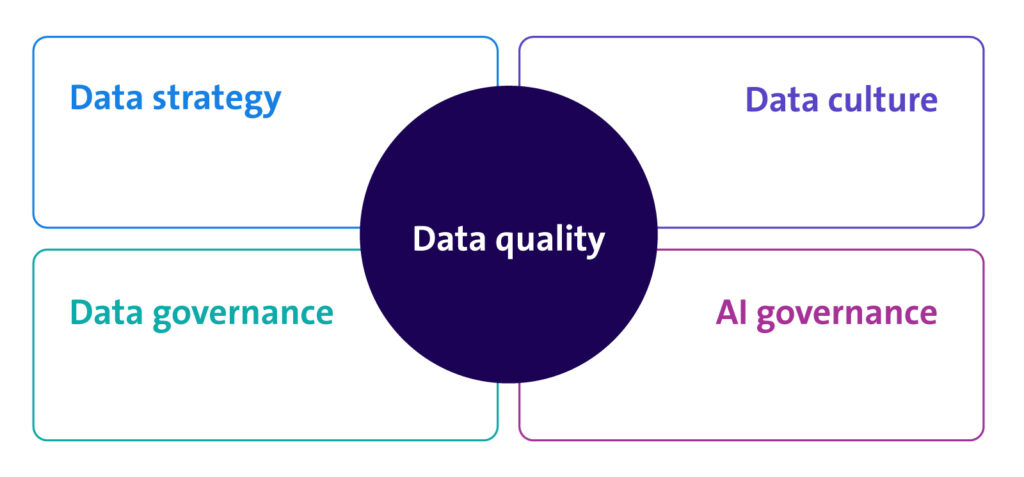
The interplay between data strategy, data governance and AI governance is crucial. Tim Giger, Principal Data & AI Consultant at Swisscom: ‘Data strategy defines what data is to be used for. Data governance determines who defines which rules, responsibilities and controls. Data management implements these rules both technically and operationally in day-to-day work. And AI governance ensures that AI is used responsibly on this basis.’
What is a data strategy?
A data strategy first answers the strategic question: what data is particularly valuable to the company, for which business objectives does the organisation wish to use it, and what are the priorities in building a robust data foundation? This determines the direction – for example, whether the focus is initially on customer data, process data, document knowledge or management reporting.
A strong data culture is just as important. Employees need to understand why data quality matters – and how their handling of data influences decisions, processes and AI results.
What is data governance?
Data governance defines rules, responsibilities and processes for handling data. It clarifies which data sets are business-critical, who is responsible for them, which quality requirements apply and how they can be accessed, interpreted and managed.
Data governance combines three areas: data management, IT security, and compliance and ethics. Data management ensures that information is quality-assured, maintained and usable. IT security protects it against unauthorised access or loss. Compliance and ethics functions ensure that the handling of data is legally correct, traceable and responsible.
‘The prerequisite (…) for avoiding erroneous AI results is solid data management.’
Swiss AI Playbook 2026 (1st edition)
What role does data management play?
While data governance defines rules, roles and responsibilities, data management ensures that these guidelines are implemented in day-to-day work. This involves not only structured information in tables, databases or systems, but also unstructured content in documents, e-mails, images and knowledge databases. It is precisely these unstructured data sets that have become much more important with GenAI.
In sum, the rise of AI has made data management even more relevant, and it relates to the management of data throughout its entire lifecycle: capture, structuring, maintenance, quality assurance, documentation and regulated use. The Swiss AI Playbook 2026 (1st edition) also stresses that sound data management is a prerequisite for avoiding faulty AI results.
What is AI governance?
Data governance and AI governance are often mentioned together, but they fulfil different tasks. Data governance creates the prerequisites for quality-assured data, while AI governance governs the responsible use of AI systems. The focus is on questions such as: which AI applications are allowed? Where is human verification needed? And how do companies check whether results are reliable, traceable and appropriate? Fairness also counts. Companies need to examine whether training and usage data is representative, whether bias can arise, and how they can identify and reduce bias risks.
Regulatory developments also play a role here. The EU AI Act may become relevant for companies with links to the EU market. It takes a risk-based approach and sets different requirements for transparency, management and tracking depending on the type and area of application of an AI system.
How much data strategy and governance does AI need?
The principles of data strategy and data governance apply to all companies. As soon as AI is deployed, AI governance arises as a further building block. The main difference lies in the scope and formalisation. SMEs can start pragmatically with a small volume of business-critical data, clear responsibilities and simple quality rules.
Large companies usually require more formalised roles, overarching standards and governance structures. In regulated sectors, there are also industry-specific provisions, such as FINMA requirements in the financial and insurance sectors, data protection and information security requirements in the healthcare sector, or legal requirements for traceability and archiving in public administration.
In general, the most important step is not to immediately set up a comprehensive governance structure, but to start with the business-critical data and AI use cases. Clarifying responsibilities, quality criteria and usage rules creates a solid foundation for effective AI.
Data & AI Governance white paper
How can companies ensure better data quality for AI? The white paper shows how SMEs and large companies prioritise relevant data, define responsibilities and pragmatically implement data and AI governance.