

Although Swiss companies have been testing GenAI, major productivity gains have often failed to materialise. But now is the ideal time to introduce generative artificial intelligence in the form of legally compliant, productive AI assistants. Here’s how.
Generative AI is here – the key now is implementation. Management teams need to drive the integration of AI assistants within their business environments. Companies that dither and linger in the pilot phase increase their security risks and lose potential productivity.
Read more here:
Although Swiss companies have been testing GenAI, major productivity gains have often failed to materialise. The article explains why now is the time to introduce generative artificial intelligence in the form of legally compliant, productive AI assistants and how to do it successfully.
On the organisational level, it‘s less a question of technology than adoption in itself. Through consistent training and change management, employees become the key factor that can translate AI tools into measurable efficiency gains. The article also provides a framework that classifies and clearly lays out the most important technological implementation decisions.
Study: Digital Trends 2026
Learn about the key digital trends for 2026 in the latest trend paper from PAC and Swisscom – including action recommendations for large enterprises and SMEs.
The sticking point: pilot mode instead of tangible progress
Since OpenAI’s breakthrough with ChatGPT in November 2022, many Swiss companies have gained some initial experience with GenAI. They have purchased test licences, launched pilot projects or integrated their first AI applications such as intelligent chatbots. But the hoped-for leaps in efficiency have yet to materialise, observes Christof Zogg, Co-Lead Swisscom Software Products, Swisscom.
‘2026 will be the year in which Swiss companies use GenAI tools to create and enjoy real business benefits – in other words, make the switch from PoC to production mode.’
Christof Zogg, Co-Lead Swisscom Software Products
GenAI now a question of implementation for management teams
The latest Swiss IT study from Computerworld finds that the focus is increasingly on the concrete added value of AI: over the course of a year, its relevance has grown significantly. While the technology was viewed as crucial by just 35.5% of the companies surveyed in 2024, more than 60% now see it as a ‘strategic tool for data-driven decisions, automation and operational performance’.
Moreover, survey respondents indicate that productivity increases are high on companies’ agendas alongside security. In essence, visionary technologies only come into focus when they yield clear benefits. Is artificial intelligence still considered a visionary technology of the future? Definitely not.
‘AI assistants generate the biggest efficiency gains in the areas of knowledge management, process automation and content creation,’ says Christof Zogg. In other words, where in-house expertise can be made accessible, routines can be automated and AI-supported content creation (e.g. text, images, audio) enables teams to achieve better quality results more quickly.
Why live deployment of AI assistants matters now
Christof Zogg emphasises that management teams should not wait any longer to introduce AI assistants in companies – for two reasons.
- Security gaps: If you don’t act now, you run the risk of data security vulnerabilities. Shadow AI means employees feeding sensitive data into unofficial AI tools. Cisco’s Data Privacy Benchmark Study 2024 found that globally, more than half of employees have already entered sensitive corporate data into unauthorised AI tools. Clear guidelines in the context of AI governance (permitted tools, data releases, access concepts) reduce this risk.
- Lost potential: In order for AI assistants to create operational added value, they must be connected to the company’s own knowledge. The underlying technical approach is called Retrieval-Augmented Generation (RAG): AI models enriched with in-house data and documents provide context-relevant answers and thus become truly useful tools.
In sum, if companies do not act, the potential of GenAI remains untapped while security and compliance risks rise at the same time. Companies are tackling both issues with legally compliant AI assistants (e.g.Copilot Chat,Microsoft 365 Copilot,Swiss AI Assistant from Swisscom).
Where to start – with internal processes or on the customer front? Christof Zogg explains briefly in the video.
Adoption is key: train employees, institutionalise use
When introducing AI assistants, the continuous training of employees is essential. Only trained colleagues can use them to maximum advantage – this is precisely the difference between a short-term pilot project and a long-term AI transformation.
In practice, it often turns out that two to three months after the rollout, the majority of the workforce barely uses the provided AI tools. Although there are usually small groups of dedicated users who use them frequently, without support and clear encouragement from management, the added value of generative AI remains piecemeal at best.
Regular training, clear guidelines and consistent change management are therefore essential. In particular, focus on how to handle data and tools securely (which data is permitted to use in which AI tool), targeted prompting, quality controls of the output and – in the case of agentic AI – comprehensible rules for approvals and automation.
In short, continuous training of employees is essential in order to enable them to use AI assistants productively and generate measurable efficiency gains. Companies should not lose sight of this important factor – AI is and will remain a question of managerial leadership.
Deep dive: Framework for technical implementation of AI assistants
In addition to introducing AI assistants at the organisational level, where issues such as change management and employee training are key to their successful deployment, the technical implementation requires decisions regarding the user group, place of use, data protection and sovereignty, and document access.
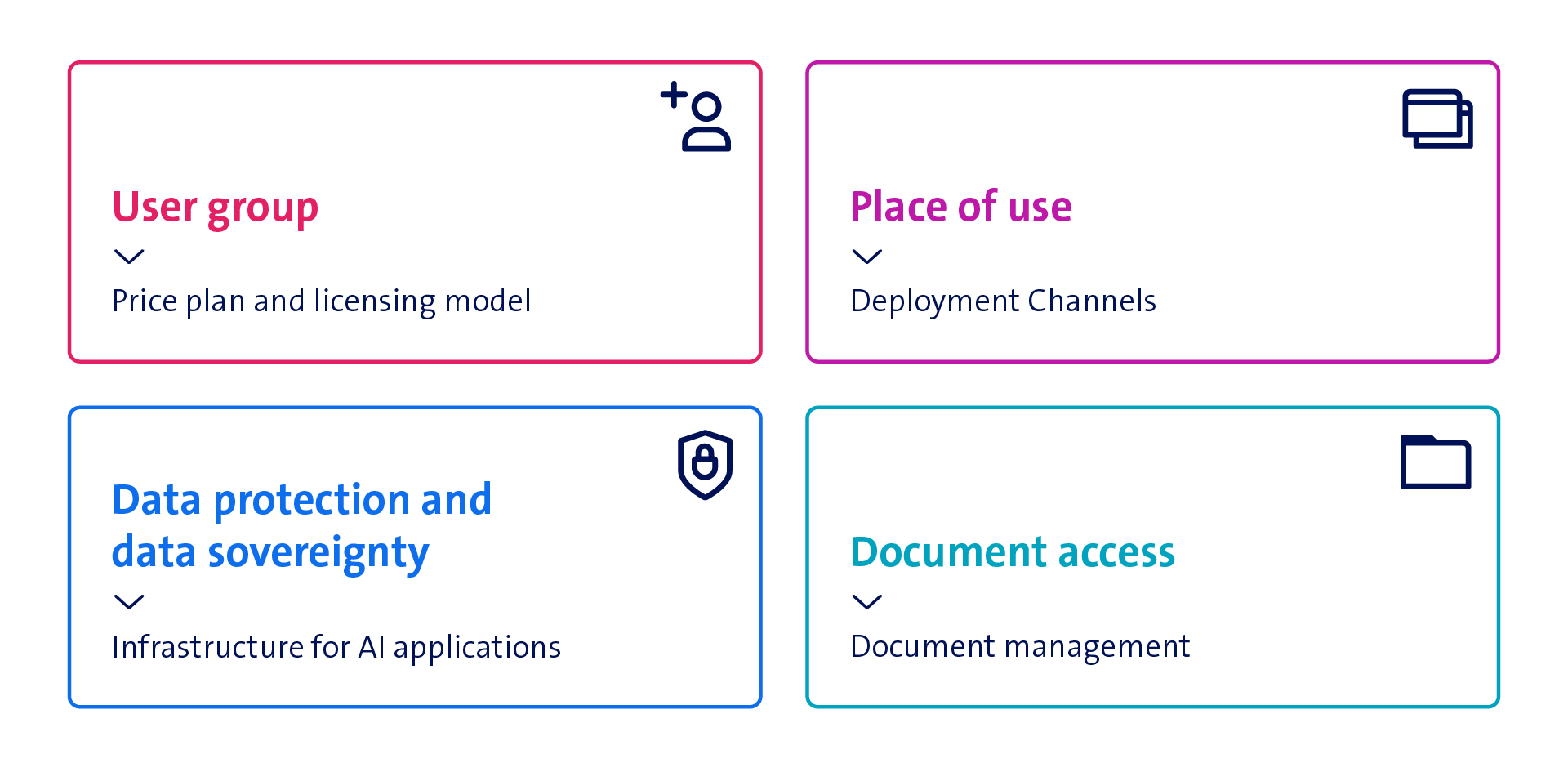
- The user group defines how many employees can use AI assistants with which roles. Depending on the user group, the price plan is either a price per user and month/year, usage-based billing (pay-per-consumption) or a flat rate per month or year.
- The place of use defines where employees can use AI tools. Deployment channels could be a standalone web app, a web application integrated into the intranet or an AI assistant embedded directly in the productivity suite (e.g. in M365/Teams, Google Workspace, etc.).
- Data protection and data sovereignty are key. They determine how strict the requirements for data storage and data processing have to be. Depending on their needs, companies can choose between hyperscalers or public clouds, a Swiss private cloud with data storage and processing in Switzerland, or on-premises in their own data centre.
- Document access defines which documents AI assistants are allowed to access, from which storage locations (e.g. SharePoint/OneDrive, file servers, internal knowledge databases) the access takes place, and which authorisations apply. Document management therefore has to define whether content is to be provided manually per assistant, whether secure access to existing repositories/fileshares is possible, or whether entire data sources should be connected – always including rights management and data classification.