AI-ready without a large-scale project? How companies can create the right data foundation
Posted onText: Saskia Wyss | Media: Swisscom
AI makes data problems visible sooner and with greater consequences. But how can companies create a viable data foundation without neglecting day-to-day business or embarking on a large-scale project? Tim Giger, Principal Data & AI Consultant at Swisscom, has some practical tips.
Why AI can’t scale without a good data foundation
Artificial intelligence requires a reliable foundation: clean data, traceable knowledge, clear responsibilities and a common understanding of what information can be used for what purpose. It is for precisely this reasons that data quality is not just a nice-to-have. Tim Giger, Principal Data & AI Consultant at Swisscom: ‘Without robust data quality, an AI investment soon leads to correction work and – in the worst case – a security, compliance and trust risk.’
‘Without robust data quality, an AI investment soon leads to correction work and – in the worst case – a security, compliance and trust risk.’
Tim Giger, Principal Data & AI Consultant at Swisscom
How can companies pragmatically improve data quality?
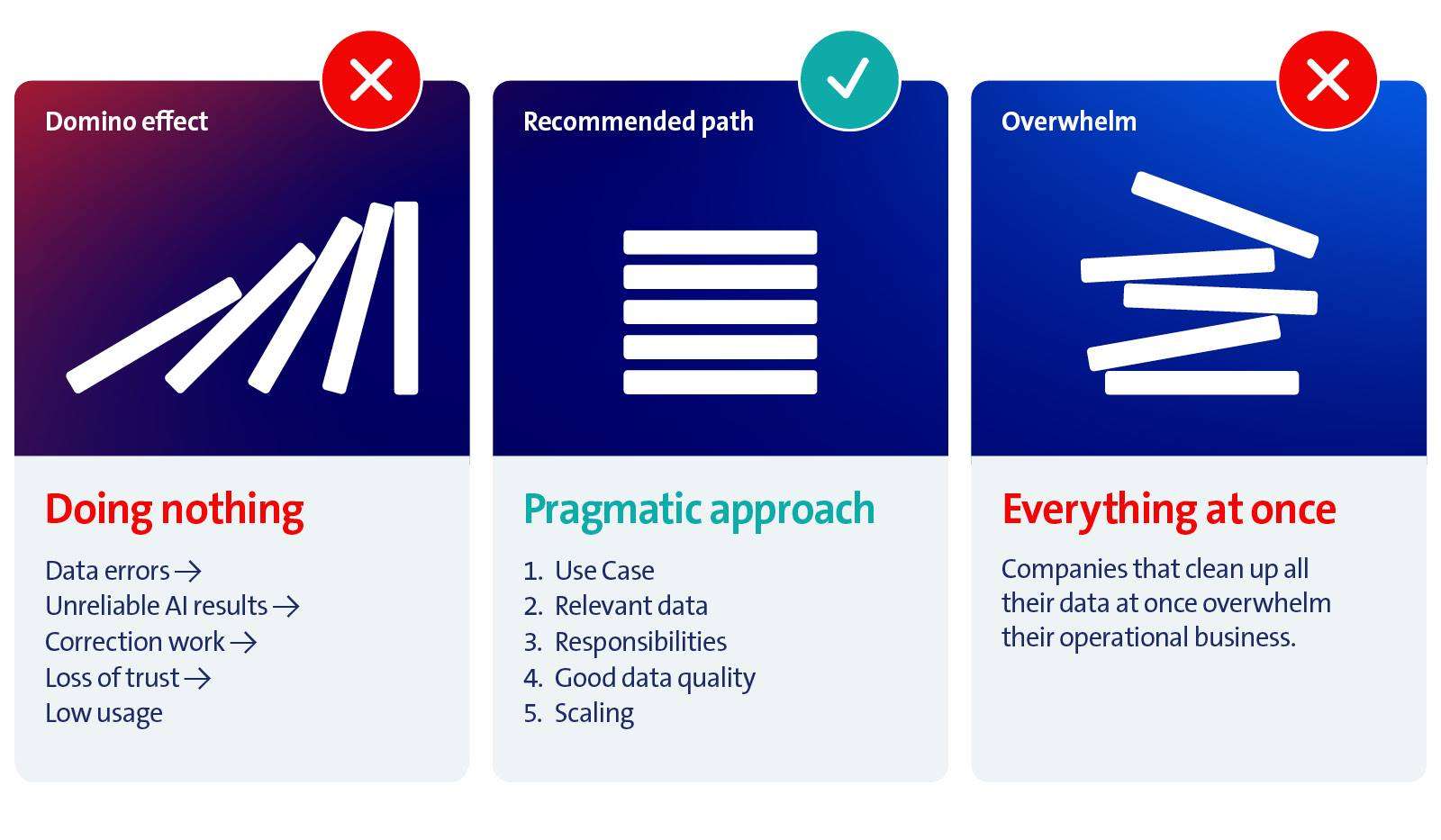
There are ways of improving data quality pragmatically, even without a large-scale project. The key issue here is finding the right balance. That goes for both SMEs and large companies. When you do nothing, problems accumulate and create a domino effect: data errors and correction work increase and ultimately there is a lack of acceptance, and employees refuse to use the AI tools provided. On the other hand, trying to clean everything up all at once can overwhelm your operational business.
According to Tim Giger, successful companies choose a pragmatic middle course. They start with a specific use case and the data relevant to that case. ‘The practical lever for better data quality is the implementation of proper data management. Data governance provides the framework,’ explains Tim Giger.
The pragmatic middle course for ensuring data quality. Graphic: Swisscom
How do companies actually implement this pragmatic middle course?
Tim Giger believes that the four steps below are key. They show how companies can use data management as an operational element in data governance to improve data quality and resolve key governance issues around AI.
Address data quality across departments.
Start with a use case rather than a tool.
Clean up the relevant data rather than tackling everything.
Resolve key governance issues before the rollout.
White paper: Data & AI governance
How can companies create better data quality for AI? This white paper shows how SMEs and large companies prioritise relevant data, define responsibilities and pragmatically implement data and AI governance – even without a large-scale project. A practical overview with concrete recommendations from Swisscom experts Bernhard Knetsch, Tim Giger and Matthias Mohler.
* Our data protection provisions, including the online data protection policy and options to revoke data processing or unsubscribe from the newsletter, can be found here: Data protection provisions
1. Address data quality across departments
Data quality is not just a matter of IT or compliance. These two areas create framework conditions, technical implementation and security. However, it is the specialist departments who know whether the data is relevant, complete and usable in the right context. They know the processes, customer situations and quality requirements and therefore have to take responsibility for their data. ‘Data quality starts when someone enters information into the system – not just with IT,’ says Tim Giger.
All employees can contribute to better data quality. This requires data awareness and data literacy; employees need to understand what data is used for and why their input may be relevant later. Tim Giger gives an example: ‘If you close a support ticket with nothing more than a comment of “problem resolved” you’re not providing much usable knowledge for a future support chatbot. But once you understand that the training of AI models is based on precisely this kind of documentation, you have a more precise understanding of the solution and the context.’
2. Start with a use case rather than a tool
Many companies start looking for the right tool – that could be Copilot, ChatGPT Enterprise, Swiss AI Assistant or another AI assistant. These solutions are helpful for individual productivity for things like writing, brainstorming, conceptual design and programming. But Tim Giger takes a more nuanced view: ‘Secure access to AI assistants is an important and increasingly unavoidable foundation, similar to the introduction of Office 365, but it isn’t a strategic AI use case. “We’re rolling out Copilot” or “we’re using ChatGPT” doesn’t describe the specific problem that needs to be solved.’
Tim Giger says: ‘The key question is therefore not: where can we use AI? Instead it’s: what is the business problem we want to solve and what data do we need to do that?’ The use case determines data requirements, risks, quality requirements and responsibilities. So the key is not so much whether you use AI, but how well the data foundation and data quality, as well as processes and responsibilities, are prepared for it.
‘The key question isn’t: where can we use AI? Instead it’s: what is the business problem we want to solve and what data do we need to do that?’
Tim Giger, Principal Data & AI Consultant at Swisscom
3. Clean up the relevant data rather than tackling everything
Once you have identified the use case, you’re faced with the question: what data do I need for this? With AI projects in particular, it is important to consciously limit the scope. Rather than cleaning up all the data within the organisation, companies should use the use case as a filter. Here’s an example: for a marketing chatbot, the relevant marketing materials, documents and knowledge sources have to be checked and cleaned. This creates a visible reference point that indicates the storage and data quality that is expected in the future.
So the first step towards data governance is always to take stock of the situation: what relevant data does the company have? In which source systems is it stored? Which entities are included – customers, products, contracts or support cases? And which system is the leader in each case? ‘The issue of the system of record is key. When customer data is managed in a CRM and an ERP at the same time, it must be clear which system is definitive for which information,’ adds Tim Giger.
4. Resolve key governance issues before the rollout
Once the use case and relevant data have been defined, companies need to clarify the most important questions in the context of data governance and AI governance. That’s because a good data foundation alone is not enough; responsibilities, risks and regulatory requirements must be defined before the rollout. Regulated industries are subject to additional requirements, such as data protection, industry-specific requirements or regulatory review obligations. But the key questions remain the same for all companies:
Which legal and regulatory requirements apply?
What is the risk class of the AI system?
What happens if it gives the wrong answer?
What damage could it cause, particularly in the case of customer-oriented applications?
How is quality measured, and when is a chatbot, AI assistant or model ‘good enough’?
In this white paper, Swisscom experts Bernhard Knetsch, Tim Giger and Matthias Mohler show how data governance and AI governance interact and what this means for implementation.
Implementing data quality: differences between SMEs and large companies
The basic issues are similar for SMEs and large companies, but implementation differs significantly. SMEs can often take a more pragmatic approach to governance; employees with lower levels of responsibility, simple overviews, clear rules, manual sampling and automated checks for particularly critical data fields.
In terms of responsibilities, three key roles have proven successful in practice: business sponsor, data owner and IT or data protection officer. Excel is often enough for creating an inventory that assigns key data objects such as customers, products or contracts to the respective systems.
Large companies often need more formalised structures: data catalogues, master data management, data quality suites, monitoring, auditability, control landscapes, incident processes and service level agreements. Here technology has a much greater role in supporting data quality and governance. But here, too, technology is no substitute for responsibility. Data quality only improves if the organisation understands data as an asset and permanently embeds data quality in processes, roles and the culture.
What better data quality can do for your company
The benefits of good data quality often become apparent sooner than many companies expect, not as an abstract governance win, but in a very concrete way in day-to-day work:
Manual corrections are reduced: employees spend less time correcting incorrect data in Excel lists, systems and reports. Companies often underestimate this hidden effort. It consumes a significant amount of time in day-to-day work, reduces the reliability of decisions and hinders productive, results-oriented work.
Another effect is reusability: a high-quality data set can be used for multiple use cases. Data quality is therefore both foundational work and a prerequisite for scaling. Maintaining data as an asset creates a foundation on which multiple AI applications can build.
Trust arise when an application repeatedly returns correct results; employees will use a reliable AI application. If, on the other hand, it delivers bad answers early on, the tool will be labelled unusable – even if the technology is powerful. Good data quality is therefore crucial for acceptance – internally among employees and externally among customers.
More in the white paper: Swisscom experts Bernhard Knetsch, Tim Giger and Matthias Mohler show how companies take a structured approach to data quality before using AI – with practical recommendations for SMEs and large companies.
About Tim Giger
Tim Giger has been designing data and AI solutions as an engineer, architect and project manager for over 12 years. He manages complex projects across different tech stacks and industries. He also regularly shares his expertise in data engineering and ML/AI as a speaker and lecturer at the Lucerne University of Applied Sciences and Arts and the University of Applied Sciences in Business Administration Zurich.