
What if technology is not the biggest obstacle to using AI productively? Many Swiss companies already have powerful GenAI tools, yet the expected productivity gains have failed to materialise. Here is how people and AI can work together constructively.
The GenAI boom began around three years ago. Soon afterwards, employees in many Swiss companies were allowed to experiment with Copilot, ChatGPT or another AI tool for the first time. Enthusiasm was high and the first success stories began to circulate. Today, however, a different picture is emerging in many teams: the tools may be installed, but the value they deliver to the business is not yet clear. At the same time, IT leaders report that other, unapproved AI tools are already being used behind the scenes, without anyone knowing exactly which data is going where.
Key points at a glance
- GenAI delivers measurable business value only when it is used to automate relevant business processes. This is about more than choosing a tool.
- The key question is not how quickly GenAI is introduced, but which tasks it is used for and how it contributes to business objectives.
- The five human capabilities of curiosity, courage, creativity, compassion and communication are becoming central to productive collaboration with AI.
- A secure, needs-based toolkit comprising productivity solutions, sovereign company assistants and specialised agents builds acceptance and reduces shadow AI.
- AI transformation is organisational development. Alongside technology, it requires continuous learning opportunities, knowledge sharing and the deliberate use of time saved for innovation, strategy and customer relationships.
The paradox: individual versus organisational productivity
From generative to agentic AI
Discover in our in-depth white paper how AI agents (agentic AI) work and which prerequisites are essential for successful deployment within your organisation.
This is the productivity paradox of the current phase of AI: the technology works, yet a gap remains between individual productivity and measurable impact on the organisation. Many companies initially introduced GenAI as a personal productivity tool. Integrating the technology into relevant processes and redesigning work to create scalable business value is considerably more demanding.
In Switzerland, Christof Zogg, Co-Lead Swisscom AI & Software Products, sees factors that both slow down and support the use of GenAI. A strong awareness of legal and risk issues can delay adoption, while high levels of IT expertise and well-developed digital infrastructure provide a solid foundation. The crucial question is therefore not how quickly companies introduce GenAI, but which tasks they use it for and how those applications contribute specifically to business objectives.
The next stage of development could at least partly resolve the productivity paradox: AI agents and more deeply integrated solutions can support not only individual activities but also end-to-end processes. However, creating real value takes more than new tools. Companies need to select the right use cases, evolve their workflows and strengthen the human capabilities that matter most when working with AI.
What remains when AI takes over routine work?
As AI takes on more routine tasks, research and initial drafts, it becomes increasingly clear what people still need to contribute. Ryan Roslansky, former CEO of LinkedIn, and Aneesh Raman, Chief Economic Opportunity Officer at Microsoft and formerly at LinkedIn, worked with experts from a range of fields to identify five capabilities that make people irreplaceable when working with AI: the five Cs of curiosity, courage, creativity, compassion and communication.

What used to be dismissed as soft skills is becoming the defining hard skill of the AI age. For companies, this means that the five Cs are not a useful addition to an AI strategy. Once routine work falls away, they are the strategy.
Curiosity is the foundational capability on which all the others build. AI recognises patterns in existing data, but only people ask whether a task should be approached in a fundamentally different way. In day-to-day work, this might be someone in accounting who is not satisfied with the explanation that ‘we have always done it this way’. Instead, they ask why certain costs fluctuate noticeably every quarter and uncover an inefficiency that no standard report had revealed.
Courage determines what happens next. AI can calculate risks, but only people decide which risks a company is willing to take. This might be a developer who proposes switching to a new framework halfway through a project because it will serve customers better in the long term. Or a sales manager who tells a major customer openly that the solution they have requested is not the right one. Courage means acting before all the information is available, something no algorithm can do for us.
Creativity goes beyond remixing existing material, which is what AI does. It means imagining something that has not existed before. Steve Jobs invented neither the computer nor the telephone, but he imagined how the two could become a single device. For companies, creativity is not the preserve of marketing or product development. It is required in every function once AI takes over the labour-intensive groundwork.
Compassion cannot be simulated by AI, however convincing a chatbot may sound. It is the capability that prompts a manager to notice a decline in an employee’s performance, ask what is happening and calmly arrange flexible working hours because the employee needs to care for a parent. In a working world where AI increasingly structures interactions in advance, human contact becomes a differentiator, both for employees and customers.
Communication, finally, is the ability to use language to create meaning rather than simply process information, as AI does. People who can articulate precisely what they expect from an AI system and explain its outputs clearly can take human–AI collaboration to a very different level from those who merely type prompts.
The two authors emphasise that the five Cs cannot be learnt in a weekend workshop. They develop over time through genuine relationships and by tackling difficult problems. For companies, this means that the five Cs cannot be mandated. They need deliberate space in everyday work.
Shadow AI: not a discipline problem, but a signal
Many organisations initially respond to uncontrolled AI use with bans: blocked domains, strict policies and reminders in team meetings. The problem is that shadow AI almost always arises from a legitimate need. Employees turn to an unapproved tool because it helps them complete a task faster, more easily or more creatively than with the official tool. A ban does not remove that need. It merely pushes activity into channels that are harder to control and penalises precisely the curiosity that companies want to encourage.
A different approach is more effective: make security, usability and trust the foundation on which controlled use becomes the natural choice. Only when employees know that their data is protected in an approved tool will they feel confident enough to use it courageously and curiously for demanding tasks. Governance then becomes not an obstacle, but a prerequisite for employees to be willing to experiment with AI.
A sovereign toolkit rather than one all-purpose tool
Another reason AI projects stall is the attempt to meet every need with a single tool. A needs-based AI workspace with three levels makes more sense:
- Copilot in the Microsoft 365 ecosystem for personal productivity in day-to-day office work
- A sovereign company assistant, such as the Swiss AI Assistant, running on Swiss infrastructure and enabling secure, AI-supported processing of confidential and particularly sensitive company data, including where data protection or compliance requirements restrict the use of other AI solutions
- Specialised agents integrated into CRM, ERP or specialist databases to automate specific business processes
These three levels are not mutually exclusive; they complement one another. For SMEs with limited IT resources, this means that not every problem requires a new tool. For initial internal use cases, a combination such as Microsoft 365 Copilot and a streamlined, secure company AI assistant is often enough. For those responsible for AI in larger companies, it means consistently addressing the architecture question before the rollout question: which tool should be used for which task, and where should the data be stored?
Adoption needs guidance: three key levers
Even with the right tool architecture, the same pattern often emerges after a few months: usage levels off unless it is actively supported. Technology alone does not change working habits; sustained team practice does. This brings us back to the five Cs, which develop through exchange, practice and genuine collaboration rather than through the tool itself.
Three levers have proved effective:
- Easy knowledge sharing: enable employees to provide their own role-specific prompt templates within the team and exchange best practices openly. This is also good practice in communication.
- Peer-to-peer enablement through AI ambassadors in business functions who support colleagues in their day-to-day work rather than relying solely on central training. This encourages curiosity and lowers the threshold for courageous experimentation.
- Continuous learning opportunities: short, regular practical sessions and demonstrations that embed AI in existing working habits for the long term.
For IT leaders in SMEs, this is good news: these three levers require little budget, but they do require attention and consistency. For those responsible for AI and Work Smart in larger organisations, it is a call to budget for and manage enablement in the same way as the technical introduction: as a separate workstream with its own objectives, not as an afterthought.
From generative to agentic AI
Discover in our in-depth white paper how AI agents (agentic AI) work and which prerequisites are essential for successful deployment within your organisation.
From IT project to organisational development
Any company that treats AI transformation purely as an IT project will reach the same point: the technology works, but the impact falls short of expectations. The real opportunity lies elsewhere. It is to make work more human, creative and effective by handing routine tasks to AI and creating space for curiosity, courage, creativity, compassion and communication.
This leads to three practical steps:
- Create a secure, sovereign infrastructure, whether with the Swiss AI Assistant, Microsoft 365 Copilot or a combination of both.
- Invest specifically in employees’ five Cs through ambassador programmes, learning opportunities and open knowledge sharing. According to Roslansky and Raman, these capabilities develop only over time, through relationships and by solving real problems.
- Do not simply redirect the time saved by AI into more of the same output. Deliberately reserve it for innovation, strategy and building customer relationships.
The productivity paradox will not be resolved by the next tool update. It will be resolved when companies consciously redesign work around the qualities that make people distinctive. The measure of success then shifts from ‘How much time are we saving?’ to ‘How much better is the work we are producing?’
Book recommendation
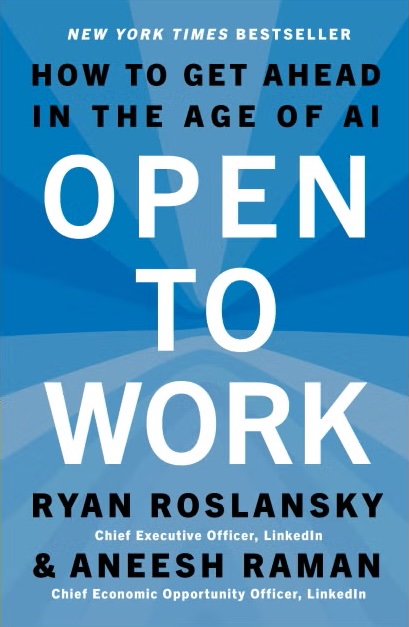
Open to Work: How to Get Ahead in the Age of AI, Ryan Roslansky, Aneesh Raman; HarperCollins, 2026. Available in English, Spanish and French.