Avaloq – the comprehensive Swiss core banking system with a global footprint

Swisscom's Core Banking Radar, developed in collaboration with the Business Engineering Institute St. Gallen (BEI), has been monitoring banks' system landscapes since 2017 and evaluates(opens in new tab) the most relevant systems for the Swiss market using a comprehensive assessment model.
Text: Christine Popp & Thomas Zerndt, Business Engineering Institute St. Gallen
Clemens Eckert, Head of Product Line Banking, Swisscom
Image: Swisscom 26 August 2026 19 min
Introduction
Whilst established Swiss systems have previously been covered in overview articles (e.g. Development of core banking systems in Switzerland) — rather than in dedicated individual profiles as has been the case for neo-systems — the plan is now to examine the core banking systems commonly used in Switzerland step by step, each in its own dedicated article. This series opens with a closer look at the well-established system Avaloq. Drawing on an in-depth interview with Avaloq and the findings of the assessment model, the article focuses in particular on Avaloq's differentiating features and the developments of recent years.
Background and Overview: Avaloq
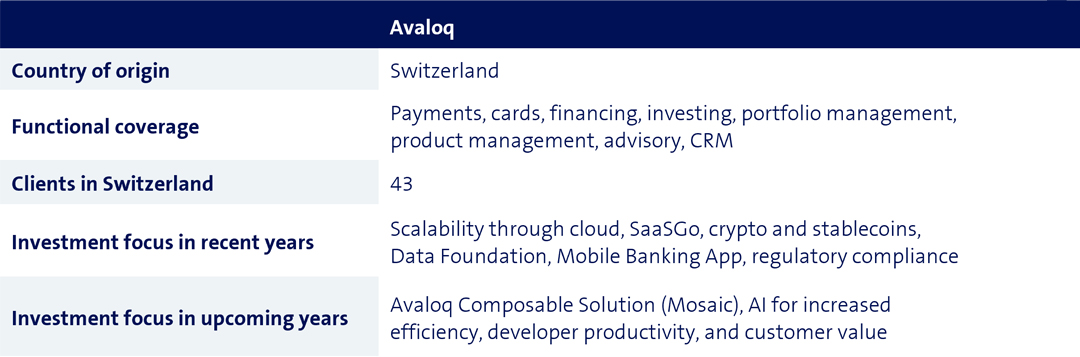
Avaloq The story of Avaloq began more than 40 years ago with BZ Informatik, a wholly owned subsidiary of BZ Bank established to build the bank's IT infrastructure. The company gave its developed IT solution the name AdvAntAge. In 2001, the IT division was spun off from the BZ Group through a management buyout, rebranded as Avaloq, and had five clients at the time. Today, Avaloq counts more than 170 clients and more than 2,500 employees globally. Its Swiss workforce is spread across Zurich, Bioggio and Geneva.
Avaloq made its first forays outside Europe as early as 2007, in Asia — Singapore in particular. In 2011, Avaloq acquired a majority stake in B-Source, based in Bioggio, a business process and IT outsourcing company, to expand its Software as a Service (SaaS) and Business Process as a Service (BPaaS) offering. This marked the beginning of a strategic focus on a Banking Platform as a Service.
In 2020, Japanese technology group NEC acquired 100% of Avaloq for CHF 2.05 billion. Through this acquisition, NEC aims to take a pioneering role in global software for Digital Finance and Digital Government. The objective is to expand and diversify internationally by investing in scalable businesses. Since 2025, NEC's Digital Government and Digital Finance (DGDF) headquarters is no longer in Tokyo, but in the same building as Avaloq’s headquarters at the Manegg site in Zurich — from where its international client base is served.
Overview Avaloq
Customer Base and Market Positioning
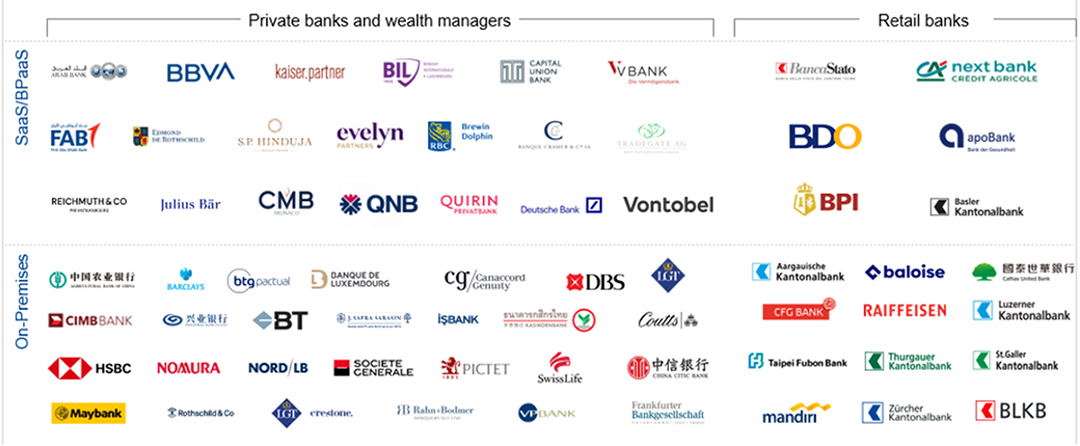
The majority of Avaloq's clients are private banks or wealth management institutions. In Switzerland, these include not only well-known private banks but also retail and universal banks, including seven cantonal banks and Raiffeisen.
According to an interview, ~45% of revenue comes from banks in Switzerland, ~40% from the rest of the EMEA region (Europe, Middle East and Africa), ~15 % from the APAC region (Asia-Pacific) — Avaloq recently secured its first client in Japan — and a small portion from the rest of the world. The expansion into the US market is being driven, among other things, by strategic partnerships, such as with the American asset manager BlackRock. BlackRock acquired a minority stake in Avaloq in 2023. Together, they offer an integrated wealth management solution). This strengthens Avaloq's positioning in the US and Europe (where it is already live with three banks).
Overview of a selection of Avaloq Clients
Avaloq addresses the varying operating models and strategic requirements of financial institutions with three graduated deployment options:
- For banks demanding maximum technological sovereignty and operational flexibility, the classic on-premises model offers complete control over self-managed software and infrastructure.
- Institutions with high customisation needs that wish to outsource pure infrastructure management whilst retaining architectural governance are served by a Platform-as-a-Service (PaaS) approach, underpinned by automation and self-service capabilities. Application management remains in-house with the bank.
- The SaaS model, by contrast, is aimed at banks seeking a Cloud-based end-to-end solution. In this model, the bank fully outsources technical complexity, with Avaloq assuming responsibility for all infrastructure management and application operations, whilst system configuration is carried out either as a bespoke setup by the bank or in accordance with Avaloq's standard configuration (SaaS Go).
With regard to infrastructure, Avaloq's current client base reflects a balanced mix of on-premises and private Cloud environments.
In the Swiss market, Cloud strategy is shaped primarily by regulatory requirements and strict data residency obligations. Multi-Cloud approaches are avoided by banks owing to the increasing architectural complexity they entail. The established hyperscalers — Amazon Web Services, Microsoft Azure and Google Cloud Platform — were long unable to offer dedicated private Cloud infrastructure within Swiss national borders. To address this specific market need, Avaloq uses the 'Oracle Cloud Infrastructure Dedicated Region Cloud@Customer' (OCI DRCC) for its Swiss SaaS clients. This is operated physically within Avaloq's data centres in Switzerland.
The international context reveals a different dynamic: whilst public Cloud structures are already in use across the Asia-Pacific region, deployment for clients in other European regions is handled primarily via the Oracle EU Sovereign Cloud.
Scope of functionality
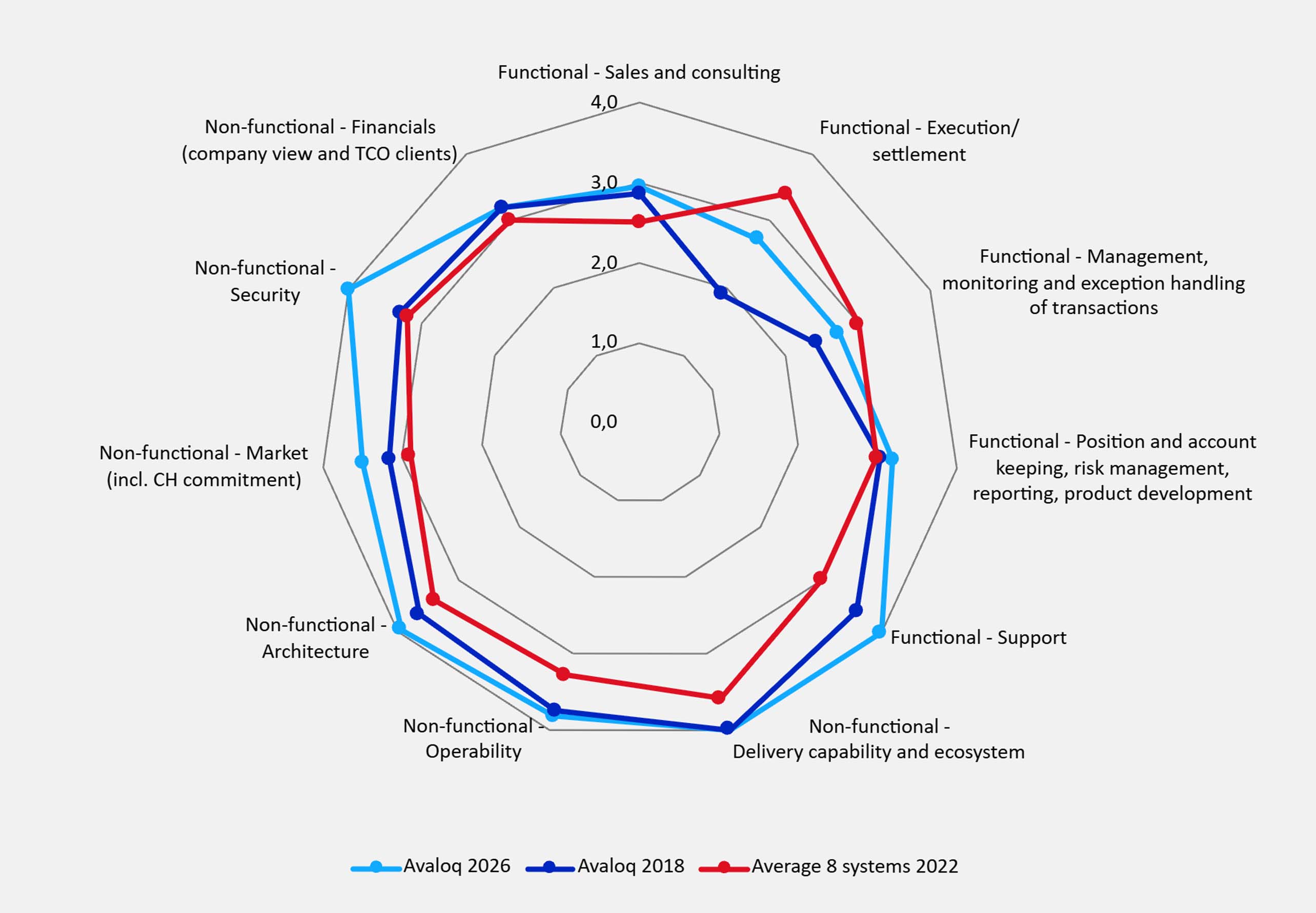
Avaloq focuses on classic banking, which is reflected in the assessment model of the Core Banking Radar (derived from the banking model): the categories Sales and Advisory, Execution and Processing, Transaction Management, Cross-Transactional and Support Functions all achieve consistently very high levels of functional coverage. This encompasses digital channels for the client interface, Customer Relationship Management (CRM), comprehensive payments functionality, lending, and the full investment domain. Integrated treasury, risk and compliance functions underpin regulatory and operational stability. The platform is further complemented by integrated data analytics tools.
Within the standardised evaluation model of the Core Banking Radar, it is evident that Avaloq has offered very comprehensive functional coverage since 2022, with only limited upside potential remaining across the assessment categories. Individual products have been extended in recent years — for example, a wallet supporting both fiat currencies and virtual currencies.
In the Payments domain, Avaloq covers everything except peer-to-peer transactions, loyalty programmes and analytical money management. The Investments domain is likewise very broadly covered, with only elements such as social trading absent. In Financing, Avaloq offers all common instruments with the exception of factoring, leasing and marketplace services (e.g. crowdfunding or real estate trading platforms).
Functional & non-functional coverage of Avaloq
Non-Functional Support
The broad coverage of the Avaloq platform is equally evident in its non-functional coverage: it ranks among the leaders in the categories of Deliverability and Ecosystem, Operability (monitoring, release approach, support), Architecture, and Security.
Third-party systems can be integrated via a partner ecosystem orchestrated by Avaloq; for around 200 third-party systems, Avaloq even assumes full application management, according to the interview. This serves two purposes: to meet regional requirements, and to allow banks to integrate technological innovations into their existing infrastructure without compromising the core architecture. As Avaloq is used exclusively in the banking sector, its rating in the Market category is somewhat lower.
The system's comprehensive coverage comes with the drawback of comparatively cost- and resource-intensive implementations and upgrades, as reflected in the Financials category — a hurdle that can be particularly significant for smaller institutions. Avaloq is committed to keeping the Total Cost of Ownership (TCO) as low as possible for client banks.
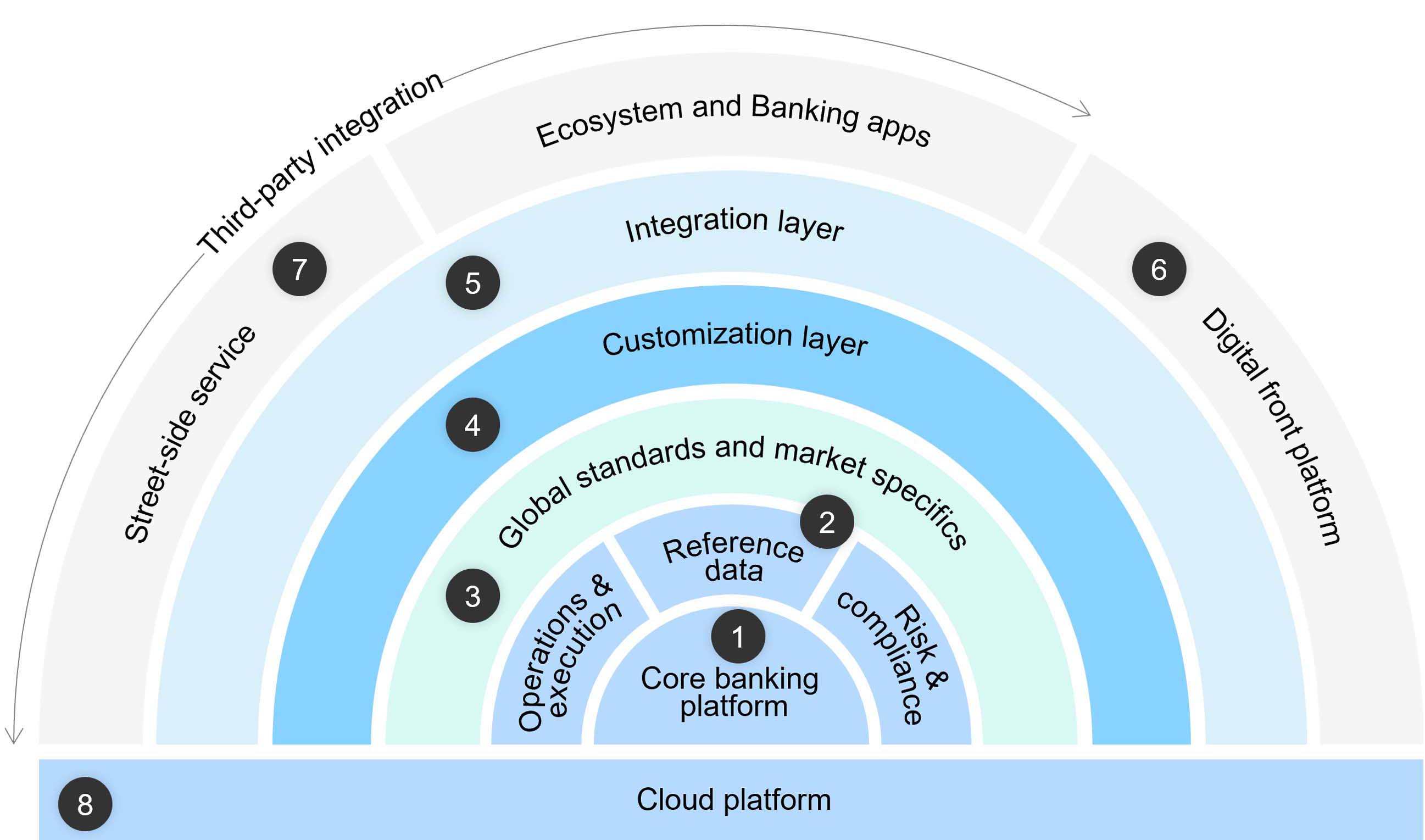
Avaloq's architecture consists, in simplified terms, of three layers, above which sits the Integration Layer (5) for technological decoupling from the core, along with the connection to digital platforms (6) and the Streetside, the Banking Apps, and the Ecosystems (7):
- The Platform Layer, which encompasses the Core Banking Platform (1) as well as the central data sources (Single Source of Truth) with Operations & Execution, Reference Data, and Risk and Compliance (2)
- The Regional Layer, which addresses global standards and market-specific requirements, thereby supporting internationalisation (3)
- The client-specific parameterisation in the Customization Layer (4)
The Integration Layer (5) provides a range of synchronous and asynchronous integration patterns. Kafka-based event streaming plays a central role in the propagation of near real-time data, complemented by API-based and other integration capabilities.The Digital Front Platform (6) shields the core platform from peak loads and ensures key non-functional requirements such as horizontal scalability and high availability.
Avaloq Container Platform Reference (ACPR) (8) is Avaloq's open, Kubernetes-based reference platform and codebase that serves as a blueprint for deploying, operating, and supporting Avaloq solutions in containerized environments.
High-Level architecture of Avaloq
For its data architecture, Avaloq employs an Enterprise Object Model. This standardised framework defines the business-relevant data objects — from clients and portfolios through to financial instruments — consistently across all systems. From Avaloq's perspective, this ensures a high degree of transactional consistency.
From a strategic IT perspective, Avaloq's core platform is underpinned by a centralized Oracle relational database, designed to provide high levels of transactional integrity and operational resilience for complex, regulated banking processes. At the same time, this proven enterprise architecture represents a long-term technological commitment for financial institutions: the tight system integration makes a platform change resource-intensive, and the corresponding Oracle licensing costs add to the total cost of ownership (TCO) of this stable foundation.
Avaloq has acknowledged this architectural challenge and is currently undergoing a transition towards a more decentralised architecture. To reduce integration effort for peripheral systems, the data model is being rigorously versioned and made accessible via a standardised API layer. The openness of the architecture allows banks to flexibly integrate external data sources — such as open data or land registry data — into the overall system and to adapt reports with greater agility. However, this does not yet resolve the transactional core's technological dependency on Oracle.
In the ongoing evolution, Avaloq is reshaping its platform architecture around a leaner and more modular core. As part of this transition, capabilities such as Customer Relationship Management (CRM) are planned to be delivered through the broader ecosystem, improving flexibility and accelerating change. The Avaloq Core is focused on reusable, differentiating core processes for transaction processing and position management. In parallel, the refactoring of legacy components is under way — the .NET desktop interface is being replaced by a web frontend, complemented by Cloud-based integration adapters that function independently of the operating model.
This enables Avaloq to support its established base of on-premises clients whilst also operating modern hybrid and SaaS models. The Zürcher Kantonalbank (ZKB) illustrates this architectural flexibility: whilst running the Avaloq core system on-premises, the bank leverages combined SaaS architectures for front-end processes and specific crypto use cases.
Investment Focus in Recent Years
To ensure continuous development, more than 20% of annual software revenue is invested in platform and services enhancement— as confirmed in interview — with Avaloq's offering roadmap shaped by users, in keeping with the credo of growing alongside its clients.
Priorities are guided by market trends and the direct requirements of banks. The development of new features is organised through community projects: banks and Avaloq product owners jointly define requirements, and multiple banks can share the development costs for solutions that all of them need.
The central focus of investment over the past four years (since the last interview) has been standardisation for improved scalability, architectural modernisation, and the expansion towards an open ecosystem. Avaloq integrates with leading open banking standards and ecosystems, including PSD2, OpenWealth and Switzerland's bLink, enabling seamless connectivity between financial institutions, fintechs and third-party providers.
Examples of Core Platform Developments Over the Past Four Years
- SaaSGo: The origins of standardised out-of-the-box blueprints trace back to developments at the Bioggio site ten years ago. SaaSGo is based on Swiss standards, is fully preconfigured, and documented for all relevant use cases. It maps the fundamental functionalities of a typical bank for a specific geographic region and is designed to be applicable to most institutions in the respective country without any initial system customisation. The methodological approach stipulates always beginning an implementation with the SaaSGo standard, and only deviating from it in a second step — when there is a specific need — to make individual adjustments.
- Regulatory by design: To address the high complexity of regulation, a central team at Avaloq coordinates the regulatory roadmap. Future requirements are anticipated from a cross-cutting perspective and systematically integrated into the system through community projects, thereby relieving banks of the burden of compliance implementation.
- Mobile Banking Architecture: As digital frontends require rapid adaptation cycles, a new app architecture together with an accompanying Software Development Kit (SDK) has been developed. The structure is consistently oriented towards persona-based experiences. This allows the frontend to be tailored precisely to the specific needs of different user groups — such as affluent clients. The implementation of the mobile banking app can be carried out and managed either directly by Avaloq, through an external integration partner, or entirely independently by the bank itself. The app's user interface is included in the licence costs as standard. Following the initial go-live at the German apoBank, Crédit Agricole is currently preparing to launch the app. In addition, a group of Swiss banks – Basellandschaftliche Kantonalbank, Basler Kantonalbank with Bank Cler AG, St. Galler Kantonalbank AG and Thurgauer Kantonalbank – are partnering with Avaloq to enhance mobile banking services for around one million clients in Switzerland.
- Crypto and Digital Assets: Offering digital assets within the service portfolio through partnerships with Fireblocks and Crypto Finance was one of Avaloq's central developments in recent years. The corresponding Crypto Assets Platform, whose development began in 2018, has been in productive use since 2022 (the first client was BBVA). It enables 24/7 trading and integrates cryptocurrencies and stablecoins — including valuation models — into traditional portfolios. The end-to-end workflow for stablecoins such as USDC and USDT is fully automated — from purchase with fiat currencies through to transfer to the target address.
- Modernization of data architecture: Through its Data Foundation initiative, operational transaction processing remains within the Avaloq Core Platform, while data is made available through a separate data layer designed to support analytics, reporting and data-driven services. This approach aims to improve the accessibility and usability of banking data without affecting core transaction processing. The underlying architecture is based on Snowflake technology and is already in productive use at selected client institutions. This data infrastructure simultaneously forms the prerequisite for future AI applications. Avaloq does not seek to compete with providers of general large language models (LLMs). Rather, Avaloq focuses on analysing highly structured banking data belonging to its clients, in order to realise bank-specific productivity and value creation use cases (such as portfolio optimisation), and may leverage LLMs for this purpose.
Investment Focus in the Coming Years
In the years ahead, development will focus on architectural flexibility and applied artificial intelligence.
Composable Banking with Avaloq Mosaic
With Avaloq Mosaic, Avaloq is building a greenfield, cloud-native, composable platform for wealth management. The platform is comprised of independently adoptable modules that integrate into existing system landscapes, core banking platforms, custodian feeds and third-party tools, rather than replacing them. The architecture is deliberately headless and integration-first: every capability of every module is exposed via APIs and the Model Context Protocol (MCP), and can therefore be consumed equally by user interfaces, surrounding systems and AI agents. This strategically opens Avaloq to institutions beyond its existing client base, not least wealth managers whose system landscapes have fragmented through acquisitions.
The functional focus lies in the areas where wealth management complexity is concentrated: multi-custodian positions, performance measurement, taxation, corporate actions and historised correctness over time.
Three modules are currently available:
- Portfolio IQ, an Investment Book of Record positioned as a middle layer between back-end systems and the channels that consume their data, providing multi-custodian aggregation and real-time performance measurement (TWR, MWR/IRR, contribution, attribution, ex-post risk);
- Agent Connect, which packages platform capabilities as governed skills and tool-use workflows for agentic assistants;
- Allocator, for discretionary portfolio management at scale with per-client personalisation, direct indexing and fractional shares.
A Tax Engine (tax-aware rebalancing, continuous loss harvesting) and an Asset Servicing module (instrument configuration, corporate-action automation) are in development. Consistent with the composable approach, modules may be adopted individually and in any combination.
Avaloq positions scalability and real-time performance as Avaloq Mosaic's central differentiator. Built entirely on serverless, managed cloud services, Avaloq Mosaic processes events in real time, eliminating dependency on overnight batch processing; compute fans out with demand, and the modules are designed to scale to millions of business entities such as portfolios. As a benchmark, Avaloq cites over two million positions processed end-to-end in under five minutes, with performance figures updated within seconds of new transactions or prices.
The data architecture underpins this: rather than relying on a centralised, normalised database, as is common in traditional banking architectures, each module owns its own data store, to date exclusively non-relational; deliberate data redundancy across modules is accepted as the price of independent scaling and evolution. Avaloq Mosaic is operated as SaaS with a dedicated, cryptographically-isolated environment ('silo') per client bank.
As with any composable architecture, the decisive questions lie less in the individual modules than in their interplay. Institutions must govern data consistency, orchestration and operational processes across the modules and the surrounding system landscape, which will place considerable demands on banks' architecture management ; the deliberate redundancy shifts the assurance of data integrity from a central database to module boundaries and interface contracts, an approach whose robustness in audit-driven wealth contexts will only be proven in operation. Conversely, the incremental model is designed to de-risk transformation: institutions introduce new capabilities in targeted steps, without big-bang migration and whilst preserving existing core investments.
However, within this phased approach, it should be noted that a hybrid parallel operation of a legacy core and new Mosaic services will place considerable demands on banks' architecture management. Specifically, the synchronisation of data between the traditionally synchronous Oracle environment and the new asynchronous microservices significantly increases the complexity of the integration layer and the operational overhead, at least in the short to medium term. Furthermore, institutions must factor in considerable development and testing efforts to ensure this newly built architecture attains the stability and maturity needed to fully and securely replace business-critical Tier-1 core processes.
Orchestrating the Avaloq ecosystem with agentic AI
Through its agentic AI vision, Avaloq is embedding artificial intelligence across banking and wealth management workflows. The introduction of new AI tools for Banking Operations and software development follows the 'Client-Zero' principle: new solutions are first implemented and used internally before going to market.
The Relationship Manager AI Agent is designed to provide relationship managers with portfolio analyses, contextual insights, and next-best-action recommendations directly within their workflow. For securities transfers, Securities Transfer AI agent is designed to support operators interpret information from multiple sources, guide workflow execution, and reduce manual effort in complex exception-driven scenarios. In this scenario, the back office's role is reduced to final review and approval. Corporate Actions AI has been in operational use since 2024 with more than 75% of Banking Operations clients at Avaloq. It applies AI to the analysis of corporate action notices, prospectuses and notification content, helping generate high-quality event data and supporting more consistent and efficient processing.
However, the broad rollout of generative AI carries risks alongside its opportunities. When systems such as Corporate Actions AI generate proposals for complex corporate actions, banks must ensure that governance expectations are met in accordance with FINMA Supervisory Notice 08/2024 on AI. The challenge lies in establishing robust human-in-the-loop processes, as AI hallucinations in booking-relevant entries can have financial and legal consequences. At Avaloq, Corporate Actions AI does not use any sensitive data, there are human-in-the-loop processes and it is not end-to-end automated.
An example of agent-based systems in technology development is the Avaloq AI Coding Assistant. This AI solution is embedded directly in the so-called ICE environment (Integrated Customization Environment), on which the standard software is tailored precisely to the specific workflows, financial products, and regulatory requirements of an individual bank. The tool, which was initially tested by internal developers, is aimed at specialists responsible for customising the core banking system. The new AI assistant supports them in writing the Avaloq-specific code required for this purpose significantly more efficiently in future.
To connect internal services, databases, and third-party tools to large language models (LLMs) as structured, verifiable functions the Model Context Protocol (MCP) is utilized as a vendor-neutral interoperability standard. The underlying architecture is LLM-agnostic, supporting various external model providers or locally hosted models depending on client requirements. However, the use of external language models entails industry-known security risks such as prompt injections or data leakage. Avaloq addresses the strict data governance requirements of banks through a tiered security concept (defense in depth). Measures such as data minimization, purpose limitation, zero-data-retention clauses with cloud services, and controlled data residency ensure that customer data remains protected and is not used for the training or fine-tuning of the underlying models.
Conclusion
Over its more than 40-year history, Avaloq has established itself as a provider offering comprehensive system support for Swiss banks, covering the value chain end-to-end across the areas of payments, investment and financing, and front-to-back from the client channel through to the back office. In the current market environment, Avaloq differentiates itself in particular through its positioning as a global platform that, amongst other things, takes on application management for approximately 200 connected third-party systems. This is complemented by numerous innovations, such as the integrated offering for crypto assets.
Avaloq aligns its strategy around five-year cycles. The strategic framework plan through to 2030 includes the ambitious goal to become a billion-dollar revenue enterprise. This growth, supported by Japanese parent company NEC, is intended to rest on two pillars: technology and market expansion. Future growth is to be driven not only by the core business but increasingly by the development of strategic markets in the United States, the Middle East, and Japan. In terms of international positioning, a critical success factor is that Avaloq maintains disciplined adherence to its layered architecture — keeping country- and client-specific customisations within the designated layers rather than allowing them to seep into the core.
On the technology side, Avaloq benefits from the R&D strength of its owner NEC. A central pillar remains co-innovation through close client partnerships, in order to ensure high acceptance and tangible business value.
In its architectural direction in particular, Avaloq consistently embraces innovation to reflect the state of the art. Four strategic cornerstones merit highlighting:
- Ongoing assurance of stability in functional scope
- Continuous improvement of scalability through targeted investment in Cloud technologies
- An AI- native strategy to enhance the utilisation of existing functionalities
- Rebuilding parts of the core through decoupling and the parallel development of a microservices-based alternative
How far this rebuilding will extend, and how much will need to be addressed through alternative transformation strategies — such as modernising existing components, integrating third-party providers, or further development — will remain an ongoing area of tension.
This is also reflected in the morphological matrix on future strategic positioning that was discussed jointly:
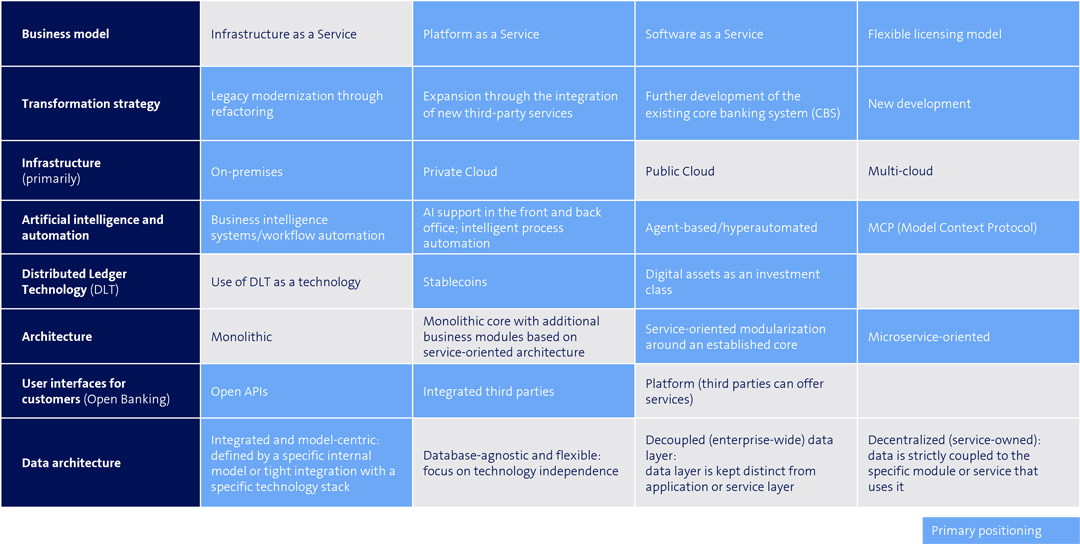
Morphological matrix for the strategic alignment of Avaloq
The business model encompasses the core forms of PaaS, SaaS and licensing models. The infrastructure focuses on on-premises and Cloud. Artificial intelligence will be increasingly prominent going forward and represents a key area of focus. The DLT offering is an integral component. The architecture combines a focus on modularisation around an established core with the development of a microservice-oriented Cloud platform. The fundamentally open architecture enables broad integration of third-party providers. The integrated data architecture is increasingly shaped by decentralised elements as well.
These developments come hand in hand with new challenges. Maintaining the core system — deeply rooted in Oracle technology — in parallel with building the modern Mosaic platform introduces considerable architectural complexity. The deep integration of AI also requires ongoing management of new IT security and data governance risks.
Avaloq is positioning itself for the future with regard to architectural modernisation, investment focus and global scaling. The continuous transformation remains defined by areas of tension and decisions between new development and modernisation. This calls for ongoing advancement with a global perspective, whilst taking local market conditions into account — such as those in Switzerland. We will continue to monitor closely the implementation of these ambitious strategies and the handling of the challenges outlined, as part of the Core Banking Radar.
Previously published articles from 2018 to 2023
- SolitX: Smart Financial Contracts as a New Approach to System Support for Banks (published 11 November 2019)
- The satisfaction of banks with their core banking systems: An area of tension? (published 10 July 2020)
- Mambu - a new generation of core banking system manufacturer relies on SaaS (published 12 January 2021)
- From Modularbank to Tuum – a core banking system that's not only for banks (published 9 December 2021)
- Vault Core – a hyper-configurable neo-core banking system from Thought Machine (published 16 March 2022)
- Neo Core Banking Systems and their importance for the IT Architecture of the future (published 16 August 2022)
- Development of core banking systems in Switzerland – a market overview (published 27 April 2023)
- SaaScada – data-driven, customisable core banking system (published 22 November 202)
- Expert Interview: There will be an increased push towards open architectures and platform architectures (published 7 August 2023)
- Challenges for IT infrastructure at Swiss banks when introducing wholesale central bank digital currencies (wCBDC) (published 17 June 2024)
- Challenges for IT infrastructure at banks in Switzerland when introducing a digital Swiss franc for end customers (published 15 August 2024)
- 10x Banking – Modern core banking system set to shape the future of banking for the benefit of customers (published December 2024)
- (R)Evolution of core banking systems: transformation strategies by providers in Switzerland (published 19 May 2025)
- What experts expect from a next-generation banking platform for 2030 and beyond (published 8 December 2025)