Update on neo core banking systems – from agile challengers to integrated enablers

In cooperation with the Business Engineering Institute St. Gallen (BEI), Swisscom’s Core Banking Radar has been monitoring banks’ system support services since 2017 and analysing the most relevant systems for the Swiss market using a comprehensive assessment model(opens in new tab). This article summarises the latest developments in the six neo core banking systems, which were presented in detail in the Core Banking Radar.
Texte: Christine Popp & Thomas Zerndt, Business Engineering Institute St. Gallen,
Image: Swisscom 17 November 2026 17 min
Introduction – ongoing evolution rather than radical revolution
The Swiss core banking system landscape is dominated by systems that have evolved over decades. The established core banking systems are undergoing a continual process of transformation and renewal (see articles: ‘Transformation’; ‘Avaloq’). In recent years, neo core banking systems have positioned themselves as alternatives and are seeking to enter the Swiss market. Through maximum agility, open architectures and the ability to access data in real time, they offer end customers highly relevant, personalised solutions.
But neo core banking systems are no longer seen as just a radical ‘big-bang’ replacement for classic architectures. As the current survey shows, many providers have undergone a strategic rethink. Neo systems are increasingly acting as potential complementary partners – as specialised product engines for new business areas, as digital twins, or as flexible microservice layers that can operate in parallel to the existing core system.
At the same time, solution providers are forced to continuously innovate to keep pace with rapid technological developments, in particular the breakthrough of artificial intelligence and the increasing relevance of asset tokenisation. We wanted to know exactly how the leading neo core banking systems are reacting to this market dynamic. So we conducted follow-up interviews with representatives of the six neo systems with the greatest relevance to Switzerland, which were presented in detail in the Core Banking Radar. We analysed the changes they’ve made since our last survey – and looked at where the banking support and technology journey will lead in the coming years.
Methodology and evaluation framework
All six neo systems below were first profiled in individual articles between 2019 and 2024, when we analysed their non-functional and functional coverage using the comprehensive Core Banking Radar assessment model(opens in new tab). Furthermore, an overview article was published in 2022 covering the neo systems that had already been analysed at that time: Mambu, SolitX (Ariadne), Tuum, and Vault Platform (Thought Machine). The previous scores for the systems just mentioned date back to 2022, while SaaScada's are from 2023 and 10x Banking's are from 2024.
In 2026, we conducted follow-up interviews, identifying innovations and future developments using the proven assessment model and arranging them in a morphological schema.
Based on this evaluation, the current article provides an overview of the six neo systems and presents them side-by-side. In the coming weeks, a dedicated deep dive into each neo system will follow.
Profiles of the six neo systems
10x Banking
The English neo system 10x Banking (described here in the first article, 2024) is an API-first core banking platform with a headless design that can be operated as an SaaS or on-premise solution. Every action in 10x triggers an event in real time according to the ‘API in, events out’ principle. The architecture divides the system into the ‘Fabric’ base layer for central data elements (such as accounts and transactions) and the ‘ProductKit’ expansion layer for flexible service design.
While the ProductKit provides extensive out-of-the box configurability, generous extensibility enables deep adjustments: banks can develop bespoke functionalities externally in any programming language and seamlessly dock them to the core via hooks. The platform is used by global Tier-1 banks such as JP Morgan Chase.
Currently, 10x is driving functional expansion in the deposit, credit and corporate banking business, and in the future it will focus on complete deployment flexibility so it can operate in a wide variety of configurations. However, 10x has consciously decided against engaging with the securities business.
USPs
- Extensibility: To augment native configuration, banks can programme extra functions in any programming language outside the platform and dock them back to the core system via an API.
- Equivalence of SaaS and on-premise: In strategic terms, the system sees the self-hosted on-premise solution and the SaaS version as equivalent.
- Focus on event production: Instead of setting up its own functionalities, 10x has a strategic focus on producing events from the core for third-party providers and processing them externally (API in, events out), with no GUI of its own (consistent headless design).
Ariadne
The Swiss company Ariadne Business Analytics (first article, 2019) uses the open-source standard ACTUS for its SolitX and AnalytX systems to map all financial instruments as smart financial contracts based on 32 payment patterns.
This algorithmically standardised representation of contractual payment obligations (cash flows) enables the seamless and consistent processing of all banking products, from current and saving accounts to financing, structured products, and derivatives. This makes SolitX the only neo core banking system that can also cover the securities business.
Rather than trying to replace existing core banking systems, the solution now functions as a complementary ‘universal product engine’ to booking engines. Serving as a single source of truth, Ariadne’s digital twin technology allows historically grown bank application landscapes to be mapped, coordinated, or replaced in real time.
Through reduced interface complexity and ISO-compliant, machine-readable and machine-processable contract logic, Ariadne creates the technological foundation for future developments such as tokenisation, distributed ledger technology (DLT) and agentic finance.
USPs
- Investment business: Only neo CBS with securities coverage (product configuration without software changes and complete product lifecycle management for all financial instruments).
- Digital twin technology: Precise historical tracking and real-time representation of all cash flows from other systems (incl. legacy systems) for valuation, predictive analysis and financial risk management.
- Tokenisation through programmable, contractual mapping: genuine natively digital financial contract logic based on the open-source ACTUS standard, instead of a pure ‘digital photo’.
Mambu
Founded in Berlin and now based in Amsterdam, the SaaS provider Mambu (first article, 2021) operates a cloud-based banking platform for a global range of customers – from universal banks and neo banks such as N26 to fintechs like the Swiss provider bob finance.
Based on a composable and API-first architecture, the platform focuses on the lending and deposit business and, through the new ‘Mambu Payments’ option, a decoupled payment infrastructure for international payment flows. Mambu seamlessly integrates special functionalities such as securities trading and card issuing via its partner ecosystem.
By implementing an MCP server for the secure connection of AI agents and the integration of stablecoins, the company is strategically aligning itself with the requirements of future banking technologies.
USPs
- Uncompromising cloud-only model: The company strictly rejects on-premise installations in favour of agility and scalability. Mambu can only be purchased as SaaS operated by Mambu.
- Decoupled payment infrastructure: The system’s Mambu Payments platform represents an agnostic infrastructure for processing global payment flows completely decoupled from the core system itself.
- Conscious elimination of complex in-house processes: For strategic reasons, Mambu doesn’t acquire its own brokerage licenses, operate trading venues or directly issue credit cards, and instead leaves these functions to third-party providers.
SaaScada
London-based SaaScada (first article, 2023) is a cloud-native core banking platform based on an API-first architecture that acts as a service and integration layer and is already in productive use internationally and in Switzerland via the local AWS region.
One key technical feature of this system with microservice architecture is the event processor that strictly separates transaction processing from data projections. Using a configuration engine, the system breaks down traditional product silos and facilitates the creation of tailor-made financial products using the modular principle, while simulating hypothetical scenarios in real time. As a result, SaaScada enables both established banks and third-party providers to bring new services to market quickly, scalably and cost-effectively.
In strategic terms, SaaScada is preparing for future LLM integrations that will further accelerate product development and data analysis.
USPs
- CQRS patterns that keep transaction processing and data projections technologically separated.
- Pay-as-you-grow fee model based on number of accounts, in contrast to module- and transaction-based approaches.
- Immutable ledger and compensation events: All raw data and events are stored unchanged; while old entries cannot be deleted, new compensation events (adjustments) ensure transparent corrections.
Thought Machine
All financial products are defined in a separate configuration layer via Python-based smart contracts, which enables fast product development without interference with the core code. The company also offers Vault Payments for processing card and account payments. It also has a user-friendly graphical interface that transforms what was a headless-only system into a broad infrastructure platform.
USPs
- AI-supported code generation: Requirements are formulated using natural language, from which the AI model autonomously generates and tests the Python code for ‘smart contracts’.
- Strict separation of core and configuration: There is a strict architectural division between the central platform layer and the bank-specific configuration layer, which allows for risk-free system updates without changes to the source code.
- Absolutely cloud-agnostic: The system can be operated anywhere Kubernetes is running (AWS, GCP, Azure or Red Hat OpenShift).
Tuum
The Estonian core banking provider Tuum (first article, 2021) offers its cloud-native and cloud-agnostic solution with SaaS, private cloud and on-premises deployment options based on decoupled, independent microservices. Tuum is currently expanding from the retail and SME segment into international corporate banking.
The functional core combines accounts, deposits, lending, payments, cards and Islamic banking in one platform, while allowing modules to operate independently. It features an integrated subsidiary ledger and a configurable ‘product factory’, while special areas such as wealth management are deliberately integrated via open REST APIs from third-party providers. Tuum’s co-existent architecture enables banks to replace legacy capabilities incrementally or undertake a full core migration. In addition, Tuum has recently invested in enhancing the user experience across its existing interfaces.
In the future, the company will focus on functional consolidation in commercial banking as well as the targeted use of artificial intelligence and agent-based systems to optimize back-office operations as an open, AI-ready system of record.
USPs
- Functionally rich, modular banking platform built by people with a strong financial background.
- Highly configurable and extensible: Product factories and open APIs allow banks to launch offerings and adapt operations promptly.
- Deployment flexibility and AI readiness: Supports SaaS, private cloud and on-premises deployments, with an open architecture for integrating AI and agentic systems.
The table below compares selected core characteristics of the neo core banking systems reviewed.
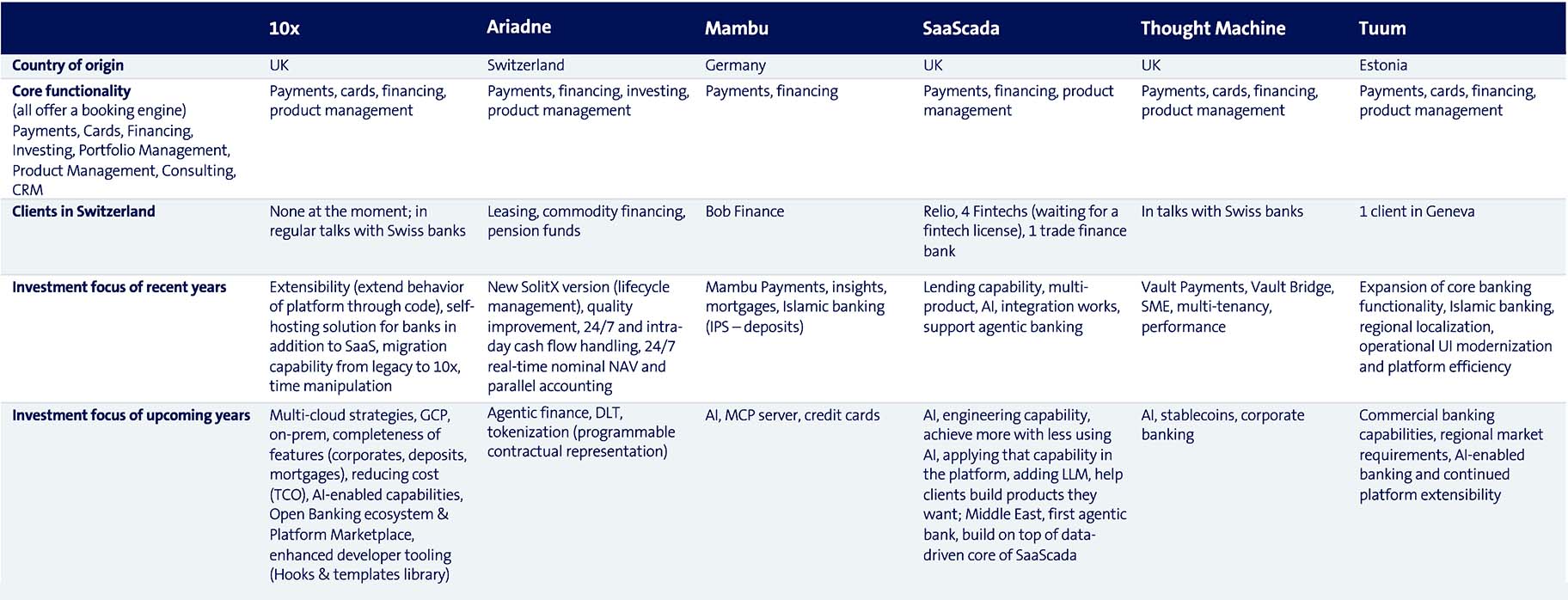
Figure 1: Characteristics of the neo core banking systems examined in the Core Banking Radar
Compelling developments from the interviews
The radar chart below shows the five functional and six non-functional categories of the Core Banking Radar(opens in new tab) and the average coverage of these categories by the neo systems.
Coverage of functional criteria is significantly lower than non-functional coverage. Expanding functional coverage takes time and is simply not the primary focus of many neo core banking systems, as they strive for the targeted integration of functionalities via third-party systems instead of trying to match conventional systems by offering the broadest possible functional coverage. In particular, all neo systems largely exclude sales and consulting, with these functionalities often connected via CRM systems.
Nevertheless, the neo systems have increased coverage in four out of five functional categories by an average of 0.2 points in the last three years. In some cases, individual providers have invested more in expanding core functionalities. The radar chart also shows the maximum value for each category. The average across all systems in the area of support remains the same, although the maximum for one system is an outlier, as another system has completely outsourced a support area to the bank and no longer offers it itself.
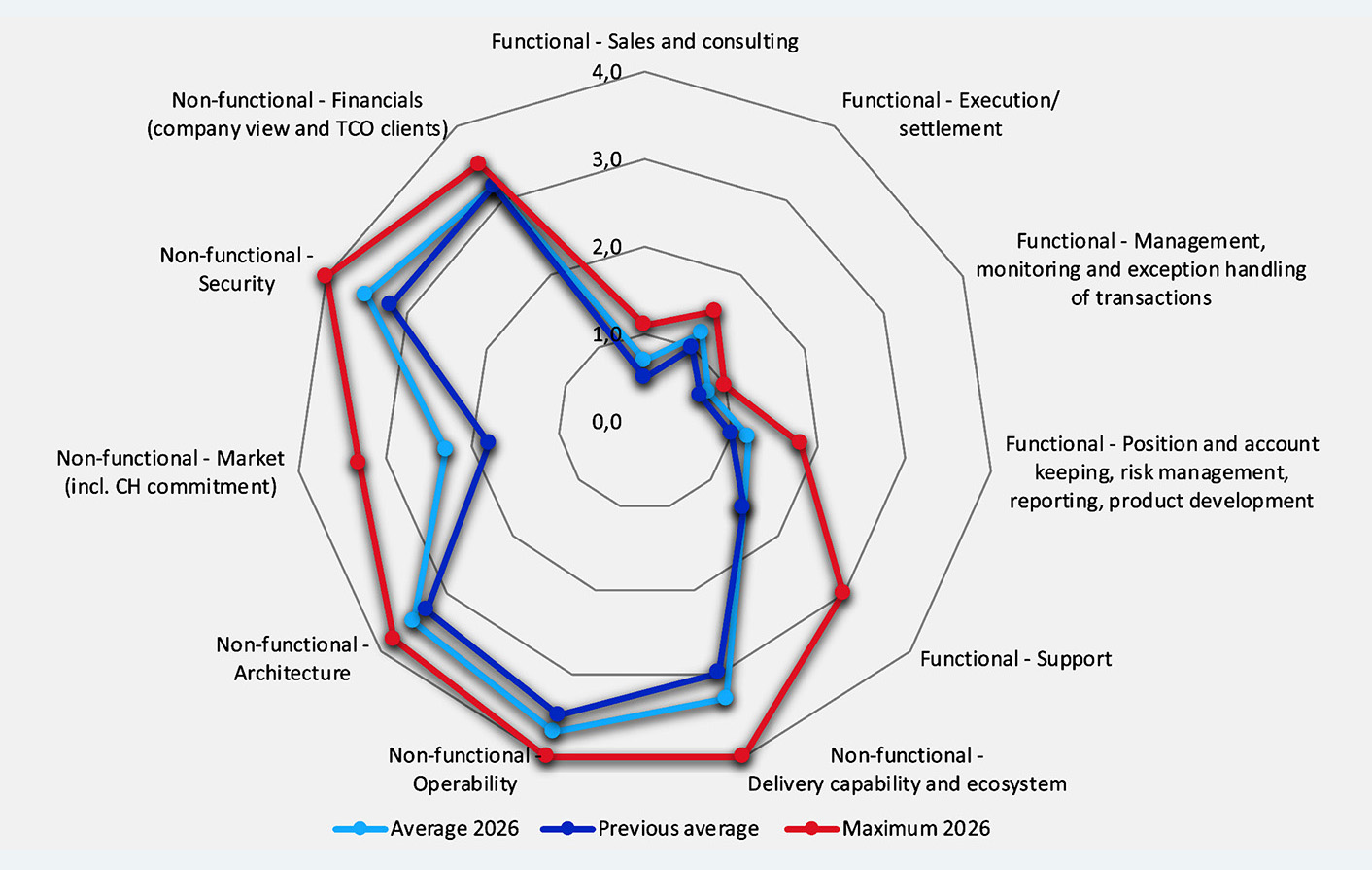
Figure 2: Functional and non-functional coverage of the six neo systems according to the Core Banking Radar assessment model
In the non-functional area, the graphic points to impressive developments since 2023. The ‘market’ category stands out in particular for the following reasons (ordered by number of mentions):
- The number of reference installations has increased
- The number of users has increased
- The system was adapted to Swiss needs
- More resources are stationed in Switzerland
- The system has experienced growth throughout the world as well as in Switzerland
- The system has attracted customers from new industries
In the four categories of deliverability and ecosystem, operability, architecture, and security, the average coverage increased by 0.2 to 0.3 points, starting from an already very high base in the initial survey. For financials, the average remained at 3.5, despite more flexible cost structures in some systems; in others, for example, there is a smaller percentage of turnover available for ongoing developments.
There are a number of overarching developments that can be identified across the different systems in recent years.
- Coexistence and extensibility:
Today’s systems often complement each other. Instead of risky ‘big bang’ replacements, they enable low-risk parallel operation with existing systems – such as specialised product engines and digital twins. The strict separation of the platform core and configuration layer also allows bank-specific adjustments in third programming languages without compromising the stability of the core code. - Decoupling of payments:
Processing of global payment flows, card networks and transaction gateways is increasingly separated from the core booking system and operated as a stand-alone, microservice-based infrastructure layer. - Global scalability and internationalisation:
Where many neo core banking systems were once focused on specific domestic markets, the examples surveyed have increasingly developed into platforms that can be used internationally. Integrated multi-entity architectures, native multi-currency capability and flexible localisation options – such as operation in local cloud regions or the rapid adaptation of country-specific compliance requirements – make them increasingly suitable for cross-border use. - Expansion of services:
Where retail and lending dominated a few years ago, providers are now expanding their portfolios to include dynamic deposit solutions, complex mortgage structures, Lombard loans and system-wide real-time simulations. They are also increasingly covering the complex corporate client business (e.g. cash management, trade finance). In addition, the consistent decoupling of product logic and platform core allows the seamless mapping of highly specific requirements, which facilitates incorporation of niche topics such as Islamic banking without architectural intervention.
Conclusion – neo core banking systems are coming of age
The second analysis of the six neo systems shows that the market has matured. Start-ups with a purely API-first and headless focus have become integrated infrastructure providers and are increasingly seeing value in their own user interfaces and extended orchestration layers (such as integrated workflow engines). As the table comparison (see Figure 3) shows, the established core banking systems continue to dominate due to their comprehensive functional coverage in all Swiss business transaction types, particularly in the area of investment and complex financing. The strengths of neo systems, on the other hand, lie in their modern, agile technological base.
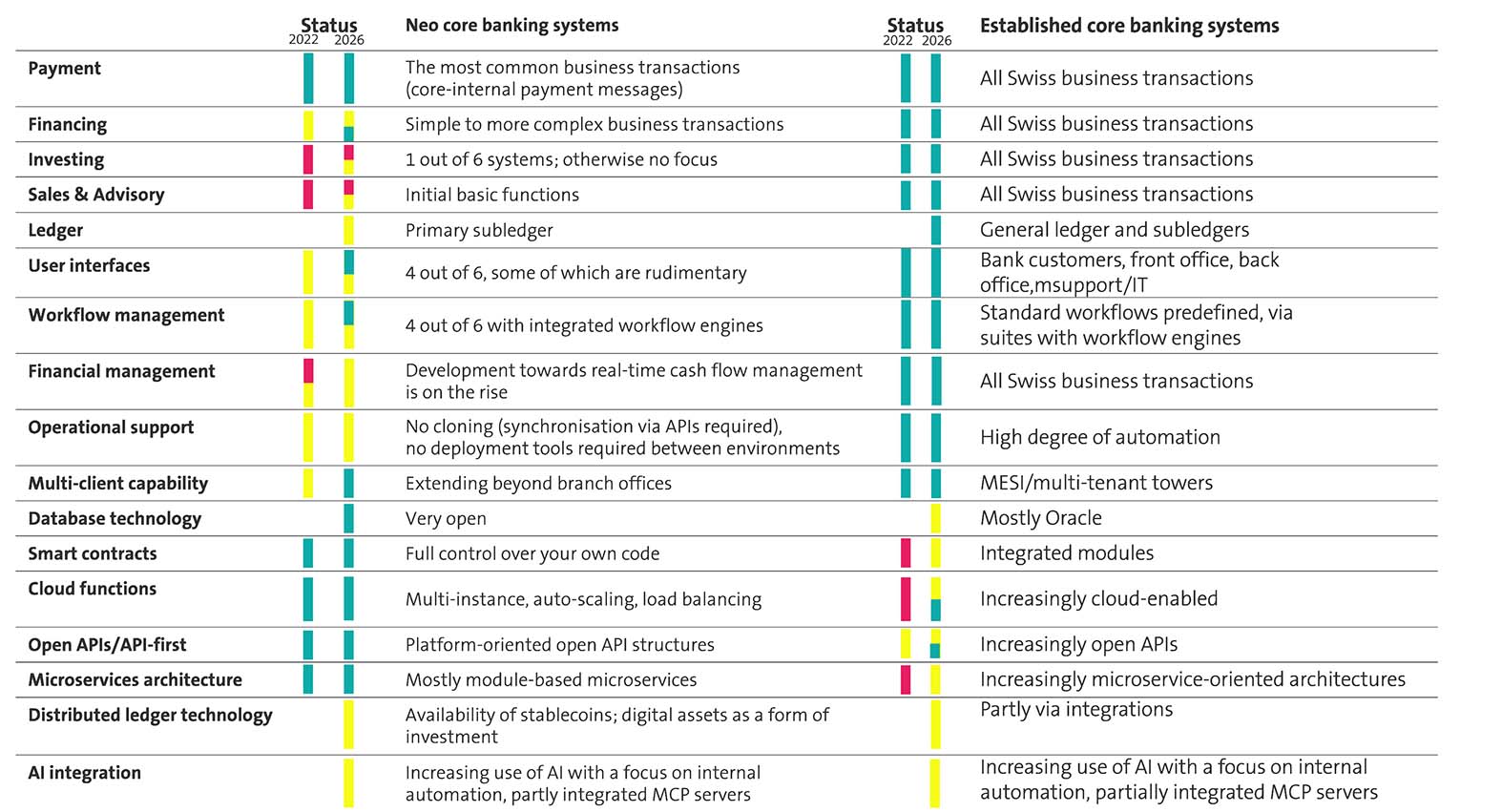
Figure 3: Differences between neo systems and established core banking systems (first illustrated in the neo review article from 2022)
All six neo systems surveyed, without exception, are based on microservice-oriented architectures and open APIs. This is reflected in a highly flexible data architecture in which the data is often strictly linked to the respective microservice, but is sometimes also orchestrated by a company-wide data layer or a data lake.
Cloud-native solutions (SaaS) dominate the delivery model. The preference for the public cloud is noteworthy – particularly from a Swiss perspective – because this is precisely where tension with strict local regulations arises. To reflect this and avoid compliance hurdles, providers are increasingly open to hybrid models. They are expanding multi-cloud strategies and dedicated on-premise options. At the same time, the systems are already intensively preparing for future market requirements. AI is providing targeted support in both the front office and back office, increasingly shifting from internal code generation to the set-up of MCP servers. This enables context-based, secure interaction between agentic AI and core bank data.
Almost all neo systems are preparing their structures for the native processing of stablecoins and digital assets. In future, they will be processed and booked via the same exact APIs as traditional fiat currencies – usually in combination with specialist external custodians.
For established banks, these developments lower the technological barrier to using neo systems to expand their own capabilities. The strategic question today is no longer necessarily whether a traditional system can be completely replaced by a neo system. Instead, the issue is whether companies can use the new providers’ flexible, increasingly AI-based architectures with real-time capability intelligently in parallel with the broad functionality of existing architectures to safeguard their innovative strength and market competitiveness in the long term.
Articles already published between 2018 and 2025
- Core banking system manufacturers open up to FinTech innovations(opens in new tab) (published 15 March 2018)
- Expert interview: ‘We expect evolutions rather than revolutions’(opens in new tab) (15 March 2018)
- Leveris: Banking support is central to the digital ecosyste(opens in new tab) (published 23 August 2018)
- ‘One size doesn’t fit all’: Core banking manufacturers are increasingly relying on digital ecosystems(opens in new tab) (published 30 May 2019)
- SolitX: Smart Financial Contracts as a new approach to system support for banks (published 11 November 2019)
- The satisfaction of banks with their core banking systems: An area of tension? (published 10 July 2020)
- Mambu - a new generation of core banking system manufacturer relies on SaaS ‘Mambu’ (published 12 January 2021)
- From modular bank to Tuum – a core banking system not just for banks (published 9 December 2021)
- Vault Core – a hyper-configurable neo-core banking system from Thought Machine (published 16 March 2022)
- Neo Core Banking Systems and their importance for the IT Architecture of the future (published 16 August 2022)
- Development of core banking systems in Switzerland – a market overview (published 27 April 2023)
- Expert interview ‘There will be an increased push toward open architectures and platform architectures’ (7 August 2023)
- SaaScada – data-driven, customisable core banking system (published 22 November 2023)
- Challenges for IT infrastructure at Swiss banks when introducing wholesale central bank digital currencies (wCBDC) (published 17 June 2024)
- Challenges for IT infrastructure at banks in Switzerland when introducing a digital Swiss franc for end customers (published 15 August 2024)
- 10x Banking – Modern core banking system set to shape the future of banking for the benefit of customers (published December 2024)
- (R)Evolution of core banking systems: transformation strategies by providers in Switzerland (published 19 May 2025)
- What experts expect from a next-generation banking platform for 2030 and beyond (published 8 December 2025)
- Avaloq – the comprehensive Swiss core banking system with a global footprint (published 26 August 2026)