Apple iOS or iPadOS
1. Download the beem app
Download the beem app from the Apple Store for your iPhone or iPad.

Or simply scan the QR code:

2. Log in and configure the beem app
- Open the beem app.
- Log in with your mobile number and the SMS confirmation code.
Please note: if your company uses beem Security Edition Standard or higher, sign in with your personal Swisscom Business Account. For questions about login, further information is available here - Configure the app: enable app notifications, location permissions and local network access.
3. Install the security certificate
- In the beem app, tap “Establish connection” followed by “Download security certificate” and enable the download.
- Open the settings on your iPhone and tap “Certificate downloaded”.
- Select and install the downloaded certificate “Swisscom beemNet Root CA”.
4. Trust the certificate and connect to beemNet
- Open the settings on your iPhone.
- Tap “General” and then “About”.
- Scroll all the way to the bottom and open “Certificate Trust Settings”.
- Toggle “Swisscom beemNet Root CA” to on.
- Open the beem app and tap “Allow VPN connection” followed by “Allow”.
- You are now connected to beemNet.
5. Disable iCloud Private Relay
If you have an iCloud+ subscription, you should disable Private Relay to ensure seamless operation and high-speed surfing with beem:
- Open the settings on your device.
- Tap “Mobile Service”.
- Choose the SIM card or mobile contract you wish to configure.
- Turn off “Limit IP Address Tracking”.
Android
1. Download the beem app
Download the beem app from the Google Play Store for your Android smartphone or tablet.

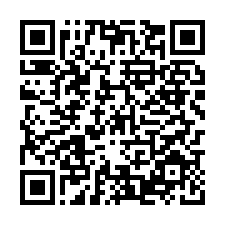
Or simply scan the QR code:
2. Log in and configure the beem app
- Open the beem app.
- Log in with your mobile number and the SMS confirmation code.
Please note: if your company uses beem Security Edition Standard or higher, sign in with your personal Swisscom Business Account. For questions about login, further information is available here - Configure the app: disable battery optimisation, allow “Display over other apps” and enable app notifications and location permissions.
3. Download the security certificate and connect to beemNet
- In the beem app, tap “Download security certificate” and confirm the download.
- Open the settings, search for “CA certificate”, select the search result “CA certificate” and then select “CA certificate” from the menu.
- Tap “Download anyway” and then select the “beemCertificate” folder and the “SwisscombeemNetRoot-CA” file.
- Open the beem app, tap “Continue” and allow the VPN connection.
- You are now connected to beemNet.
Windows
1. Download the beem app
Download the beem app for your desktop PC or laptop.
2. Install and log in
- Install the beem app.
- Open the beem app and log in with your mobile number and the SMS confirmation code.
Please note: if your company uses beem Security Edition Standard or higher, sign in with your personal Swisscom Business Account. For questions about login, further information is available here - You are now connected to beemNet.
MacOS
1. Download the beem app
Download the beem app for your Mac or MacBook.
2. Install, log in and configure the beem app
- Install the beem app.
- Open the beem app and log in with your mobile number and the SMS confirmation code.
Please note: if your company uses beem Security Edition Standard or higher, sign in with your personal Swisscom Business Account. For questions about login, further information is available here - Open the beem app, enable beem notifications, network extension and access to devices on the local network, and add the VPN configuration.
- You are now connected to beemNet.
About the beem App
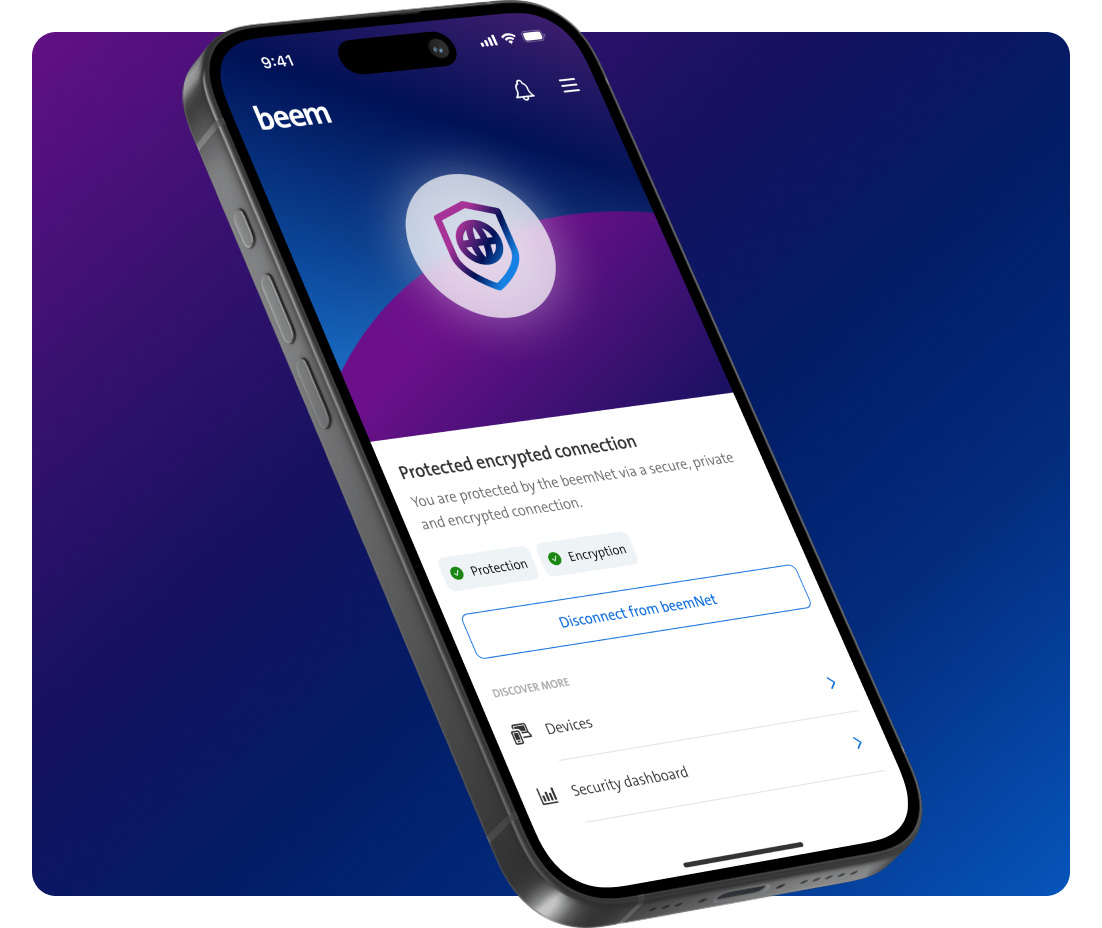
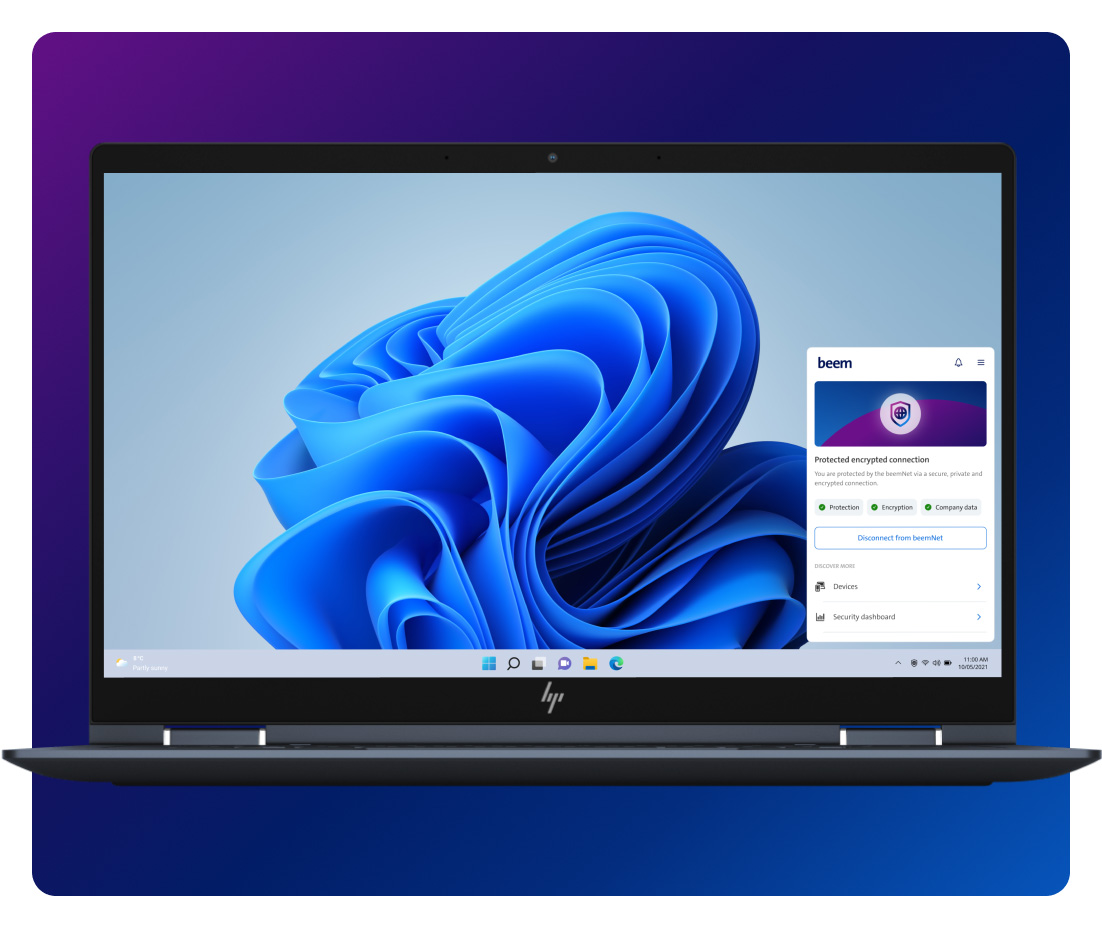
The beem App gives you straightforward access to beemNet from anywhere. The app offers comprehensive protection against cyberthreats, improved privacy online and secure access to company data and business applications. The beem App is available for smartphones, tablets and computers with Windows or MacOS.
Connect to beemNet from anywhere
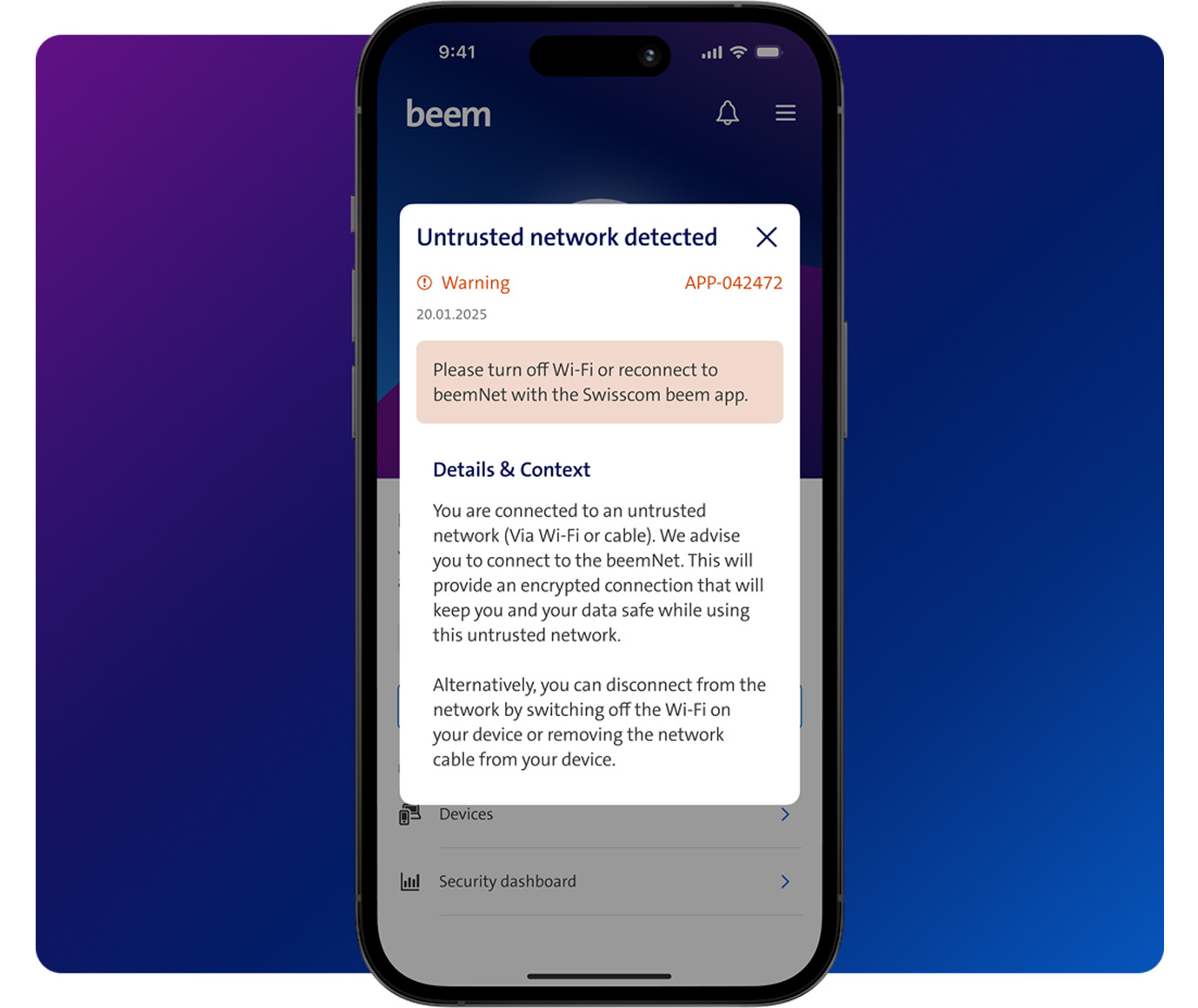
The beem App connects your computers, tablets and smartphones to beemNet wherever you are – whether working from home or using a public WLAN or even a third-party network. End-to-end encryption of the data connection allows you to surf the net anonymously, increasing your protection against targeted cyberattacks and social engineering.
Comprehensive protection against cyberthreats
With the beem App, data streams can be analysed in beemNet and harmful content blocked, giving you comprehensive protection from harmful websites, malware, phishing and viruses.
Push notifications and Security Dashboard
The beem App offers instant push notifications and a personal Security Dashboard for all devices, showing information about blocked content and averted cyber incidents. This information is only visible to you, the user – your company receives anonymised, aggregated statistics. The Security Dashboard is also accessible via My Swisscom Business and the Swisscom Cockpit.
FAQs
How it works
Why do I need the beem app?
Devices that are connected to the Swisscom mobile network via a SIM card and have been assigned a beem user licence are automatically hosted on beemNet. Company sites with a Swisscom broadband connection with beemNet (and thus all devices connected there) are also automatically hosted on beemNet.
Devices in third-party networks require the beem app to connect to beemNet. This applies to devices with a mobile subscription for Swisscom residential customers or from third-party providers in Switzerland and abroad, as well as when users connect their devices while working from home or using a public WLAN. The beem app also enables end-to-end encryption of the data connection.
In the case of customers with beem Essential, users need the beem app to benefit from advanced protection against cyberthreats on their devices. This enables, for example, analysis of the content of data packages (Deep Packet Inspection) and thus provides advanced protection against viruses and other malware.
The beem app is needed for users to receive push notifications about averted cyber attacks, prevented data leaks and the like.
For secure access to company data and business applications, the beem app is required in order to check device parameters (Device Posture Management), such as whether an up-to-date antivirus is enabled, the device password is strong enough or data carriers are encrypted. This functionality is included in beem Standard, Plus and Premium and enables advanced device protection. If user end devices are centrally managed, the beem app and the necessary certificates are automatically installed on them.
Alternatively, users can securely access company data via the beem Business Application Portal, even when using unknown or public devices, without installing the beem app. With beem Standard and above, further options are contained that provide even anonymous users with selective access to company data and business applications.
How can I access the beem app?
To use the beem app, you need a beem user licence. If you have a user licence, you can log in to the beem app with your mobile phone number or your username.
How are end devices protected?
If a device is connected to beemNet, data streams are transmitted via beemNet and subjected to numerous security checks. Unlike with many other security solutions, the data traffic in beemNet undergoes all security checks at the same time (single pass) – guaranteeing speed and high data throughput rates. Inbound and outbound data traffic is inspected and unauthorised access from the Internet as well as accidental clicks on malicious websites are blocked.
In addition to the above, devices connected to beemNet are anonymised with respect to Internet services through the use of various security technologies. This reduces the risk of erroneous security configurations and outdated operating systems, thus protecting all connected devices against cyberthreats, whether they are computers, tablets, smartphones, printers, production machines or similar.
The beem app is required in order to encrypt data traffic in third-party networks. The app also installs the necessary certificates on the end device – or alternatively these can be installed using the integrated Device Management function (with beem Standard or above) or manually. This enables analysis of even encrypted data (Deep Packet Inspection), so malware can be detected and blocked.
With beem Standard or above and the appropriate user licences, client devices with an up-to-date operating system can also be managed as an option. This enables device settings to be configured automatically to further increase security.
What is the difference between a user licence and a mobile subscription?
A mobile subscription directly connects devices to the Internet via the mobile network.
A beem user licence gives employees access to beemNet and thus a secure gateway to the Internet that protects them and their devices against phishing, malware and other cyberthreats. Furthermore, user licences are not restricted to SIM-enabled devices; they can connect PCs, Macs, tablets and smartphones to beemNet, regardless of which mobile network or WLAN they are connected to. The user licences also enable secure access to company data and business applications, for both employees and business partners.
Our mobile subscriptions (Protect & Connect for SMEs and NATEL® go with beem for large enterprises) are an integral part of the beem user licences and are available in different variants, such as Swiss or Europe. When using the Swisscom mobile network, these mobile subscriptions are automatically connected to the beemNet rather than the public internet, without the need to install or activate anything.
Which content does Swisscom analyse in beemNet?
With beem, your data traffic is analysed in beemNet, automatically and exclusively by automated means, in order to detect and prevent attempts to access harmful websites or download malware. Content is not censored; only access attempts and files deemed harmful or malicious from a cybersecurity perspective are blocked.
When analysing data traffic, beem decides automatically whether or not a security check is required and if so, if this should be basic or comprehensive. For a comprehensive security check – for example, to check for viruses and other malware – data must be temporarily decrypted so that the content can be analysed (known as deep packet inspection or DPI). This comprehensive security check is only available with the beem app. The decryption is fully automated and performed exclusively in Swisscom data centres in Switzerland. The data is then immediately re-encrypted. No content is stored.
The entire analysis is automated – nobody within Swisscom or our partners has access to your data. The whole process, from start to finish, complies with Switzerland’s strict data protection laws and security standards. There is temporary storage of anonymised, technically necessary information only, and your content remains confidential at all times.
Questions about setting up the beem app
What are the system requirements for using the beem app?
The beem app is available for Windows, MacOS, iOS/iPadOS and Android. Details about the supported client operating systems(opens in new tab) can be found on beem docs.
What is a certificate and why do I need to install it?
The beem app needs to install a special certificate on your device in order to protect you effectively while you surf online. The certificate allows encrypted data (e.g. HTTPS websites) to be temporarily decrypted so that it can be analysed in beemNet.
This certificate is called “Swisscom beemNet Root CA” and is issued directly by Swisscom. The certificate ensures that the beem app can establish a secure and trusted connection to Swisscom’s beemNet, therefore serving as a form of digital ID that enables secure communication between your device and beemNet.
You can find further information about Root CA certificates(opens in new tab) on beem docs.
Why do I need to disable iCloud Private Relay on iPhones/iPads?
iCloud Private Relay (also known as Apple Private Relay) is a data protection feature in iCloud+. Private Relay conceals the IP address of your device, among other things, to protect your identity and privacy while you browse the Internet. It is designed to work primarily with the Safari browser and selected apps on iPhones, iPads and Macs – so it does not cover all the data traffic on the device.
beem also protects your privacy by concealing your IP address but additionally checks websites and files for harmful content. If iCloud Private Relay is enabled, some of the Internet traffic is rerouted and therefore bypasses beem. This means that beem can no longer fully protect and control the data traffic, which can cause firewall and DNS problems, loss of performance when surfing and reduced transparency. In order to ensure that beem can function properly and allow you to enjoy high-speed surfing, we recommend that you disable Private Relay on your iPhone or iPad.
You can find technical details about beem with iCloud Private Relay(opens in new tab) on beem docs.
On how many devices can I install the beem app?
You can install the beem app on as many devices as you like. However, simultaneous use on multiple devices is limited and depends on your user licence, the selected mobile subscription and the availability of any multi-device options.
For example, Protect & Connect Swiss includes two devices, while Protect & Connect Global includes six. All subscriptions allow you to add extra devices with the multi-device option. Our subscription overview shows you how many devices and/or simultaneous app users are included.
The Protect user licence requires you to choose the specific number of devices you would like to protect.
Why do I have to log in repeatedly?
You are asked to log in each time for your security: the process ensures you are a verified beem user and not attempting to gain unauthorised access. Your login is only valid for a certain period, so you will need to log in again each time it expires. This enables us to preserve a trusted connection and comply with applicable security guidelines (e.g. ISO standards). The frequency of logins depends on which Security Edition your company uses, and the approach is designed to strike a balance between protection and user experience.
We will call you. Now or at a time to suit you.
Contact us in writing