

Generative artificial intelligence can significantly improve the employee experience, among other things, by increasing efficiency. This, in turn, has a positive impact on competitiveness and business success. What added value does GenAI offer for your company? Find out with ‘return on employee’.
Article summary
Why is GenAI important for the employee experience?
GenAI enhances employee experience by automating routine tasks, providing personalized support, and enabling more efficient work in an attractive, modern environment.
What is employee experience?
Employee experience encompasses all the moments and experiences employees have throughout their time at a company – shaping motivation, productivity, and engagement.
What role does GenAI play along the employee journey?
GenAI supports staff at every touchpoint – from recruitment to onboarding to daily work – and purposefully improves the overall employee experience.
How is GenAI’s success in employee experience measured?
Success is measured by the Return on Employee (ROE), based on quantitative usage data (for example, time savings) and qualitative employee feedback on the support provided by GenAI.
What does Return on Employee (ROE) mean?
ROE is a strategic KPI that shows how digital tools such as GenAI improve the employee experience and how this contributes to achieving company objectives. It makes the value of investments in technology and employee experience visible.
Why does employee experience also concern leadership, IT and communications?
Employee experience is not just the concern of HR. Leadership, IT, and communications are also involved. Interdisciplinary collaboration ensures that employees understand, support, and effectively implement change.
Study: Digital Trends 2026
Learn about the key digital trends for 2026 in the latest trend paper from PAC and Swisscom – including action recommendations for large enterprises and SMEs.
Why is GenAI important for the employee experience?
GenAI tools such as Microsoft Copilot, ChatGPT, Google Gemini and Perplexity.ai are the hallmarks of the modern workplace. Initially, the biggest benefit of these innovations lies in the automation of routine tasks and personalised support. With increasing capabilities in prompt engineering and more extensive application scenarios, the potential will shift to specific business values in the future.
Swiss companies already taking advantage of these opportunities and creating a modern working environment are laying the foundations for this shift and have a greater chance of attracting talent, making processes more efficient and gaining a competitive edge.
GenAI usage in Swiss companies
Nevertheless, it seems that employers have yet to exploit the benefits these digital solutions offer in practice in their companies: according to the PwC study ‘Findings for Switzerland – Workforce Hopes and Fears Survey 2024’, 57% of employees at Swiss companies say they feel overwhelmed by the plethora of technological innovations, and half report a significant increase in their workload; only 18% use GenAI in their day-to-day work.
On the other hand, Swiss companies recognise the importance of good workplace organisation in terms of their attractiveness as employers: In the 2024 MSM Research study on the workplace, they rated its relevance at 3.29 out of a total of 4 points. In addition, 74% see increased efficiency as the biggest gain from AI.
GenAI and employee experience put to the test
Why is it that the added value of GenAI is not yet evident? On the one hand, the technical foundations need to be in place, i.e. capital expenditure on cloud solutions will become indispensable. On the other hand, organisational measures also need to be taken:
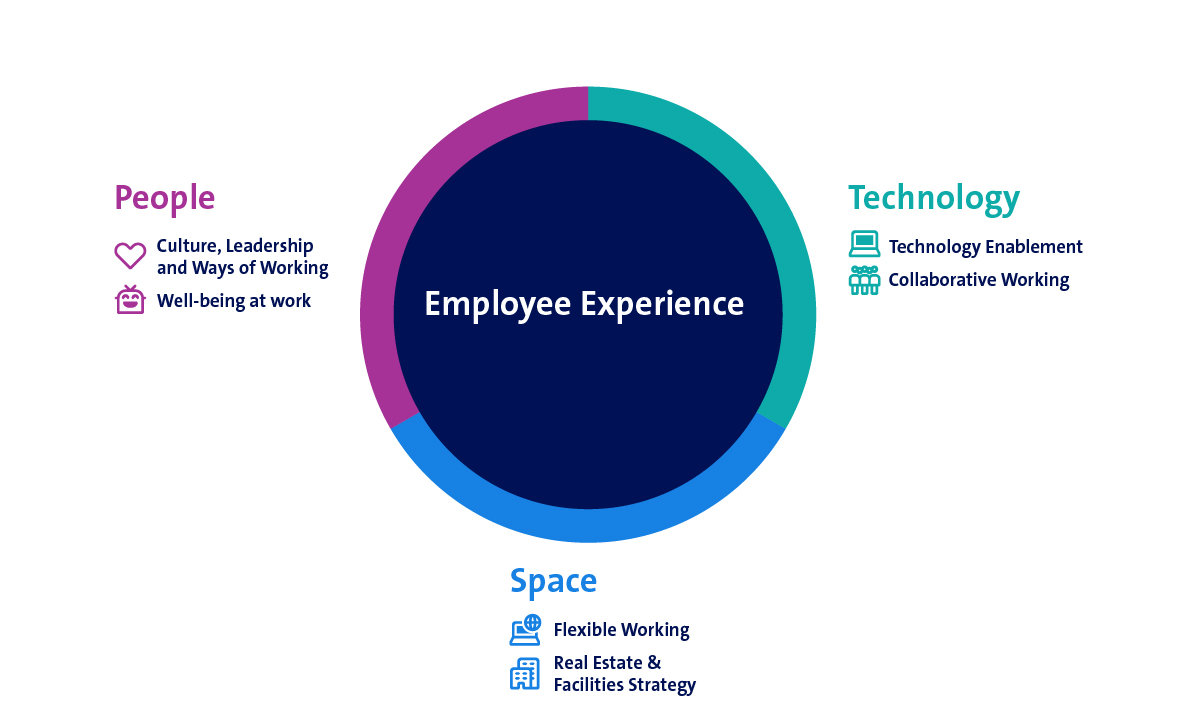
- Holistic work experience: Companies can enhance the added value from current digital developments by viewing the work experience as an ecosystem.
- Integrate change management: The full potential of technologies can only be harnessed when management sees their introduction as an integral part of change management.
- Measuring employee experiences: Leaders, acting as the link between top management and teams, should measure the Return on Employee to assess the added value that technological advancements bring to employees and, consequently, to business success.
‘An outstanding employee experience is achieved by striking the right balance between people, technology and space.’
Sebastian Zolg, Product Manager New Work, Swisscom
What is Employee Experience?
The employee experience is an ecosystem encompassing people, technology and space that constantly responds to change. Changes in one dimension have an impact on the entire ecosystem. At present, people’s ability to adapt often lags behind rapid developments in the digital realm; businesses are putting a one-sided focus on technology.
There is a temptation to introduce artificial intelligence simply to highlight advances in the company. Ideally, however, the main focus should always be on whether and how innovation can lead to positive changes in the employee experience: specifically, how the various touchpoints along the employee journey can be improved.
Future work
What role does GenAI play along the employee journey?
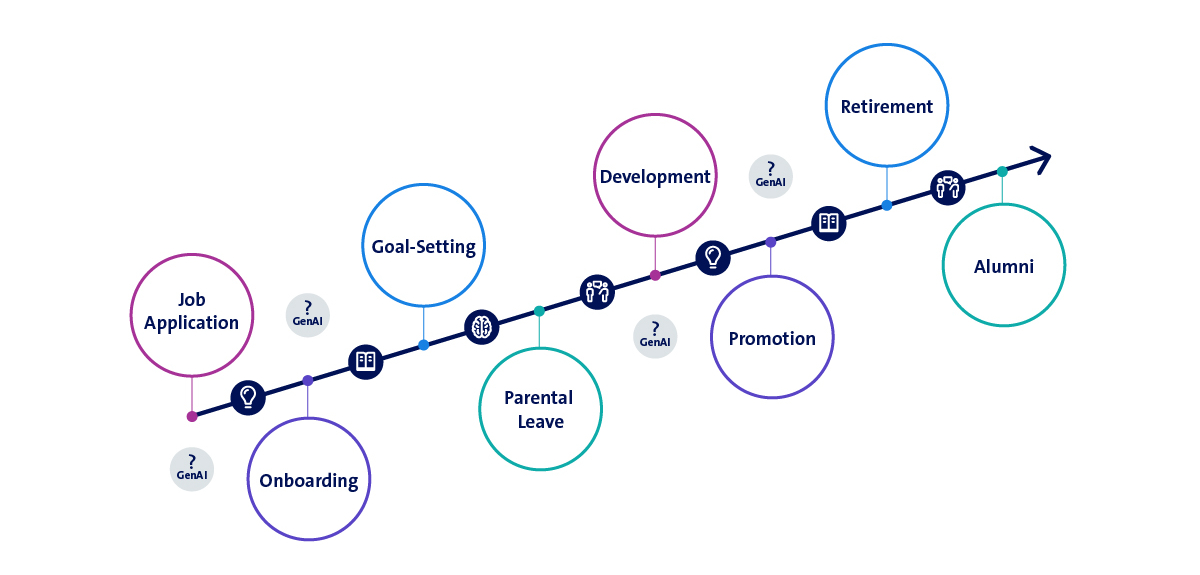
GenAI supports employees at every stage of the journey – from application through onboarding and into everyday work – and thus makes a significant contribution to an improved employee experience.
The key to successful navigation in this ecosystem is the targeted use of GenAI and the continuous measurement of benefits along the employee journey. GenAI offers employees a wide range of use cases and best practices.
GenAI has the potential to improve processes at every touchpoint: from application and onboarding to day-to-day work that consists largely of searching for information. Ultimately, the employee experience constitutes the sum of these (digital) touchpoints.
Each touchpoint must be analysed in terms of the three dimensions of the ecosystem presented: How does artificial intelligence help to achieve better results?
- How does it support collaboration?
- Where does generative artificial intelligence speed up the search for information?
- Where does automation make sense and which tools are suitable for it?
- Which digital skills do team members have and which are missing?
- How will these changes affect the corporate goals, and to what extent are they aligned with our vision and strategy?
Change management as a key success factor for New Work
The introduction and adoption of technology is part of a wider process of change that affects a company’s competitiveness. Effective change management by the management board is therefore needed to ensure that employees accept and implement the changes successfully.
Why does employee experience also involve leadership, IT, and communications?
Measures must include coordination between management, IT and HR as well as internal communication in order to make the changes transparent and understandable for employees. Without an integrated vision and strategy of where the organisation is headed, and without the empowerment and active involvement of staff in the change process, there is an ever-widening gap between technological opportunities and their actual use.
But how does the company’s management know if they are track with change management measures and promoting a good employee experience? By using a central KPI: return on employee (ROE).
‘An integrated vision, regular validation of the ROE and a cultural sponsor at management level are the success factors for a sustainable transformation.’
Petra Schmidhalter, Leader of Future Work Experiences, Swisscom
What does Return on Employee (ROE) mean?
However, many transformation projects fail to define their KPIs. What exactly do companies intend to transfer and when will the target be reached? When can we say that employees have fully adopted new digital tools? One possible answer to this is return on employee (ROE).
This KPI is related to return on investment (ROI), but focuses holistically on the employee experience rather than on productivity in isolation. It sheds light on whether the changes brought about by technology are leading to a successful work experience (Gartner, Struggling with ROI? Consider ROE).
How is the success of GenAI measured in the employee experience?
So it’s not about quantifying the value of employees, but about getting a reference on how they use digital tools and how this impacts business goals. ROE consists of directly measurable and qualitative survey data and should be related to the business goal KPIs.
For example, the frequency of use of tools can be measured directly, while employees can provide a self-appraisal of whether a tool like Microsoft 365 Copilot has saved them time and whether meetings are more effective.
They can also provide information on whether work processes are well coordinated or whether tools cause too many media disruptions, but also whether they feel competent in using digital tools and can use this ability effectively to complete their work.
Future Work Consulting
Our team of experts will guide you and your employees on their journey into the future of work with tried-and-tested change management consulting for digital process optimisation.
Recommendation: identifying use cases and measuring benefits
Due to its diverse areas of application, generative artificial intelligence presents many opportunities and challenges. This makes it all the more important to identify use cases at the touchpoints mentioned above in which GenAI offers real added value for the workforce, and to continuously measure these benefits using ROE.
Companies can identify, implement and analyse application scenarios independently or with the support of a Future Work Consultant. Empowerment measures for employees should always be included so that they can learn how to use generative artificial intelligence.
Future trend: workstyle analytics
Workstyle analytics will become more important in the future, as the method manages to analyse data from different divisions such as IT and HR in an integrated way that provides a holistic view of employee experiences. This means that cross-department cooperation is required: not only for change management, but also when it comes to analysing the use of GenAI.
To strengthen this cooperating, Gartner recommends establishing digital workplace leaders to drive the improvement of the employee experience, analyse success based on organisational goals and coordinate with stakeholders from these divisions.
Workstyle analytics as an advanced measurement method for ROE
Workstyle analytics (WSA) captures and analyses IT, HR, and business data to improve the relationship between technology investments, employee experience and operating income. By collecting information anonymously from different sources, managers can make data-based decisions and calculate ROE.
WSA assists in measuring efficiency, optimising IT investments and evaluating the productivity of the workforce. In addition, the approach helps to evaluate training effectiveness and increase employees’ digital literacy. AI, in particular, enhances the power of workstyle analytics by automating data collection and depicting work processes in real time.
The objectives of workstyle analytics
In contrast to other analytics, WSA is strongly data-driven and integrative, firstly because it enables holistic analysis from different data sources from different units, and secondly because it places it in the context of corporate goals. This principle also underlies ROE. According to Gartner, the objectives of Workstyle Analytics should be:
- Continuously coordinating specialists’ skills and roles with corporate goals
- Creating a digital-savvy workforce
- Continuously improving operating income
- Increasing employee loyalty to the company
How Return on Employee makes GenAI’s success visible
Does generative artificial intelligence lead to a better employee experience? Yes, it does when employees understand why change is necessary and are well trained and empowered to effectively integrate AI innovation into their work. This can be achieved if upper and middle management actively steer and support the change process using the approaches mentioned above.
This is the only way in which profound technological developments can improve employee experience and increase competitiveness. And it’s the only way to narrow the gap between the opportunities offered by GenAI and its actual use.
Return on employee plays a key role in creating transparency about the success or failure of this transformation. Leverage Return on Employee to guide your GenAI strategy, digitally transform your workplace, and make success measurable.
Inspiration Workshop Modern Workplace
Discover in our free inspiration workshop for large companies, how a well-designed workplace with tools such as Microsoft Copilot and Power Platform can improve your employee experience. The workshop will be conducted in German and English.
Glossary
Employee experience
This term describes all the experiences and perceptions that employees have in their working environment. These include interactions with team members and line managers, the use of certain technologies and tools, and experiences in the spatial and cultural aspects of the company. In order for employee experience to generate added value for the company’s goals, it must be accompanied by change management measures. Doing so supports the introduction of new processes, helping to overcome potential resistance and effectively ensure the transition to improved working methods.
Employee journey
The employee journey describes the entire path of an employee within the company – from application to departure. It also includes all the other touchpoints that are connected with day-to-day work and often have to do with obtaining information. Each of these touchpoints can be improved by technology, provided they take into account the individual needs and abilities of the employees as well as the spatial and technological context.
Return on employee (ROE)
This KPI sheds light on whether and how technology and digital tools improve the employee experience and how this impacts business objectives. Unlike traditional financial KPIs such as return on investment (ROI), ROE analyses all aspects of employee experience, taking into account both direct output measures (such as productivity) and qualitative factors (such as employee satisfaction). This definition of return on employee is based on Gartner (Struggling with ROI? Consider ROE). There is another, more financial understanding of ROE, which comes closest to ROI. In addition, there is return on employee experience (ROEX), which more specifically measures the impact of employee experience on customer experience, similar to Gartner’s understanding of ROE.