Swisscom Job / Diversity

"Being a dad: The longest and best job"

From divisional management to Group Management at Swisscom - for Mark Düsener, this step not only meant more responsibility, but also new challenges in balancing family and career. As a divorced and single father of four children, he commutes between Munich and Switzerland every week. In this interview, he talks openly about failure, being a role model and why he wants to empower his employees to be more independent.
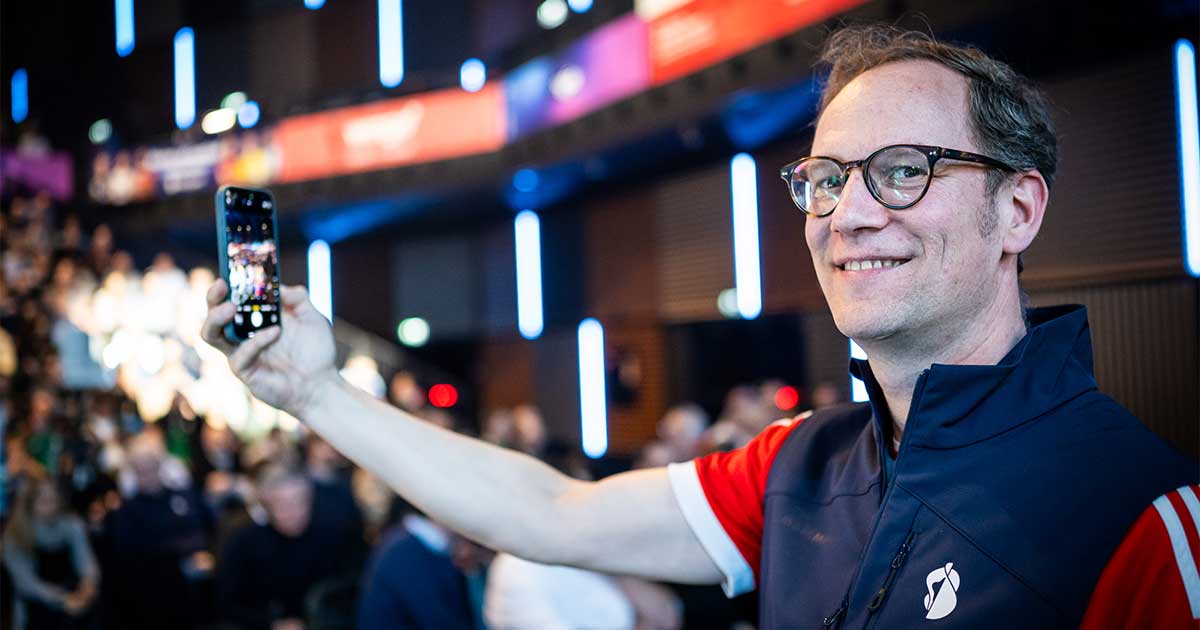
The move to Group Management - what changes did it bring professionally?  

Professionally, my area of responsibility has increased - I have to familiarise myself with areas that weren't mine before. My colleagues became my employees. It was important to me to reshape us as a management team. That's why I started my first day at work with a workshop where we talked almost exclusively about culture.

And what did the promotion mean for you in your private life?

In my private life, I am divorced and have four children - two biological children who live with me in Munich and two who came into the marriage with me and who now live with my ex-wife, with the older one already living on his own. I continue to commute from Zurich to Munich - at 14 and 16, my biological children are too anchored in Munich to move. So the commute has continued, but I've had to become more flexible: I was normally in Switzerland from Monday to Thursday and then travelled to Munich. But now there are often situations where there's something on Friday or I have to go back to Switzerland earlier on Monday. I sometimes compensate for that, after all it's the time when I miss the children. 

Did your children have a say in this career move?

I actually asked my children as well as my friends, because I realised that this new job would also affect them. 

You manage thousands of employees and have four children - what is your childcare model?

When I'm not in Munich, i.e. working in Zurich, my children are with my parents, as my ex-wife lives further away. There are also two stepchildren of my ex-wife, who I also helped raise - so it's a real patchwork, where we continue to try to be parents together . At some point, when the children have their school-leaving qualifications, I will adapt the model again. I assume that many things will become easier as they become more independent.


"If I don't enjoy my work, then I'll have to change jobs. I love working, so I don't compartmentalise it so much."

Be honest: your days are very long. Is there a work-life balance?

In addition to my new role, we had bought Vodafone Italy with Swisscom and the new CTO for Italy couldn't start until May. I then bridged these months - and these were also the months in which it was very difficult to strike a balance. However, this time also showed me how important it was to have clear mark times when I could go for a run or read a book. In general, however, I can say that there has to be a balance. But that also means that work has to be fun. I love working, which is why I don't separate my work from my private life so much. 

What is your motto?

One of my strengths is focus. During a meeting, I don't think about what's on my desk to the left and right, but about what I can or can't do to make a difference in this meeting. In short: I try not to allow the stress of "not working" - it doesn't help or change anything. 

Have you consciously set boundaries - such as "no more emails after 7 pm"?

I don't have any such clear boundaries. But as a rule, I don't work at the weekend. Of course, I check my mobile phone every now and then to see if something is on fire or there's a fault somewhere. But I do the big and time-consuming email checking and answering on the train to Zurich on Monday mornings.

And how do you and your management model support the compatibility of your employees?

My core model is empowerment. It is important to me to enable my employees to make independent decisions. The "how" is important to me. It doesn't always have to be the best experts in my team, but the teamwork and the culture have to be right. I do my job best when I no longer have to make decisions because everyone can and does everything themselves. Of course, that will never happen, but it's still my guiding principle. Managing on a small scale - that would overwhelm me and take the joy out of it.

Does the employer have to help with work-life balance?

We clearly have to support this - not because we only think intrinsically, but also for talented people who want and need certain framework conditions so that they enjoy coming to work. For example, women and men with small children: If we don't have part-time opportunities, it will be difficult to retain these employees. In my area, every position can be 60 to 100 per cent. There are female colleagues at management level who manage a team of 100 people - part-time.

A management position, i.e. managing thousands of people part-time - is that possible in your eyes?

I think it's very difficult. Why is that? My biggest tool, my biggest lever is time with people. Leading means meeting people and talking to them. I can deliver a message via the screen, but it doesn't get across the same way as it does at the coffee machine. You can only be approachable if you sit in the same canteen and can be spoken to. If I have a heavier workload, I also have less time for these encounters. The first thing I missed out on when I was also responsible for the job in Italy was precisely that: time to lead. But that's the real lever, that's how I exemplify the culture.


"I'm travelling and one of my children would like to have me with them. That hurts. But if it really hurts, then I'm on the next plane home."

You are a role model - also in terms of compatibility. How do you perceive this?

I want us to have the opportunity to talk about fatherhood, failure and work-life balance issues. An example: I'm travelling and one of my children would like to have me with them. That hurts. The important thing is that if it really hurts, I'm on the next plane home. That hardly ever happens, but my children know that I'll be there. I've done it once or twice.

When I was going through the separation process, I didn't talk to my colleagues about the challenges at first. Then I read the interview with Martin Vögeli - it really helped me to open up.

A role model starts with the question of how I want to live parenthood? There are different views on this, mine is not the right one per se. I regularly fail myself. And if I could choose, I would do it differently - then my children would be with me. That's exactly what we should be able to talk about.

How openly do top managers talk about personal pressures?

It's not a weekly topic, but we do tell each other from different contexts if there's a lot going on. We always start our meeting with a check-in. This often includes the question of what happened at the weekend. And if it wasn't so nice, then there's room for that too. There's room for that.

What do you wish your children in terms of compatibility?

Firstly, I hope that they find a job that they are passionate about. Then compatibility won't be so badly associated with the feeling of having to choose. Secondly, whatever kind of family they have, I hope that they are happy with a partner who wants to live family and professional life in exactly the same way.

That's a nice wish.

In the end, the longest and most difficult job I've chosen is being a dad. And also the most beautiful.

This article was written by  Tadah(opens in new tab)

Compatibility measures of Swisscom: 

Flexible forms of work

  • Home office
  • Mobile working in Switzerland 
  • Flexible working hours 

More time for private matters

  • Holiday purchase 
  • Unpaid leave 
  • Long-term account 
  • Sabbatical (management) 

Working model

  • Part-time (also on probation) 
  • Job sharing 

Further training programmes

  • 5 training & further education days 
  • Health programmes (stress management, self-management, etc.) 
Diversity Team

Diversity Team

More getIT-articles

Ready  for  Swisscom

Find the job or career to suit you. A career where you can make a difference and continue your personal development.

What you do is who we are.

Go to careers

Go to current cyber security vacancies