Corporate responsibility governance
The revised corporate responsibility (CR) governance entered into force on 1 January 2022 and was updated in 2025. Under these Organisational Rules, the Board of Directors of Swisscom Ltd approves the ESG (Environment, Social and Governance) strategy and defines the key non-financial concerns for the Group (including the definition of performance indicators). It manages the implementation of the measures taken by Swisscom concerning the key non-financial issues identified. Furthermore, it monitors the relevant risks associated with the key non-financial issues.
Strategic goals of the Swiss Federal Council
Based on the Telecommunications Act (TCA), the Federal Council defines the strategic objectives that the Confederation, as the majority shareholder of Swisscom, aims to achieve in the next four years. In the current period and until 2025, the Confederation expects Swisscom to pursue a sustainable corporate strategy that respects ethical principles insofar as it is economically possible for us to do so. In this respect, the reduction of greenhouse gas emissions plays a particularly important role. Moreover, where it makes sense from a business perspective, the strategy must accommodate the requirements of different regions of the country.
Incorporation in the Group’s strategy
In its business activities, Swisscom Ltd is guided by the principle of sustainable value creation, as enshrined in the Articles of Incorporation. The Board of Directors is thus committed to pursuing a Group strategy geared towards sustainability.
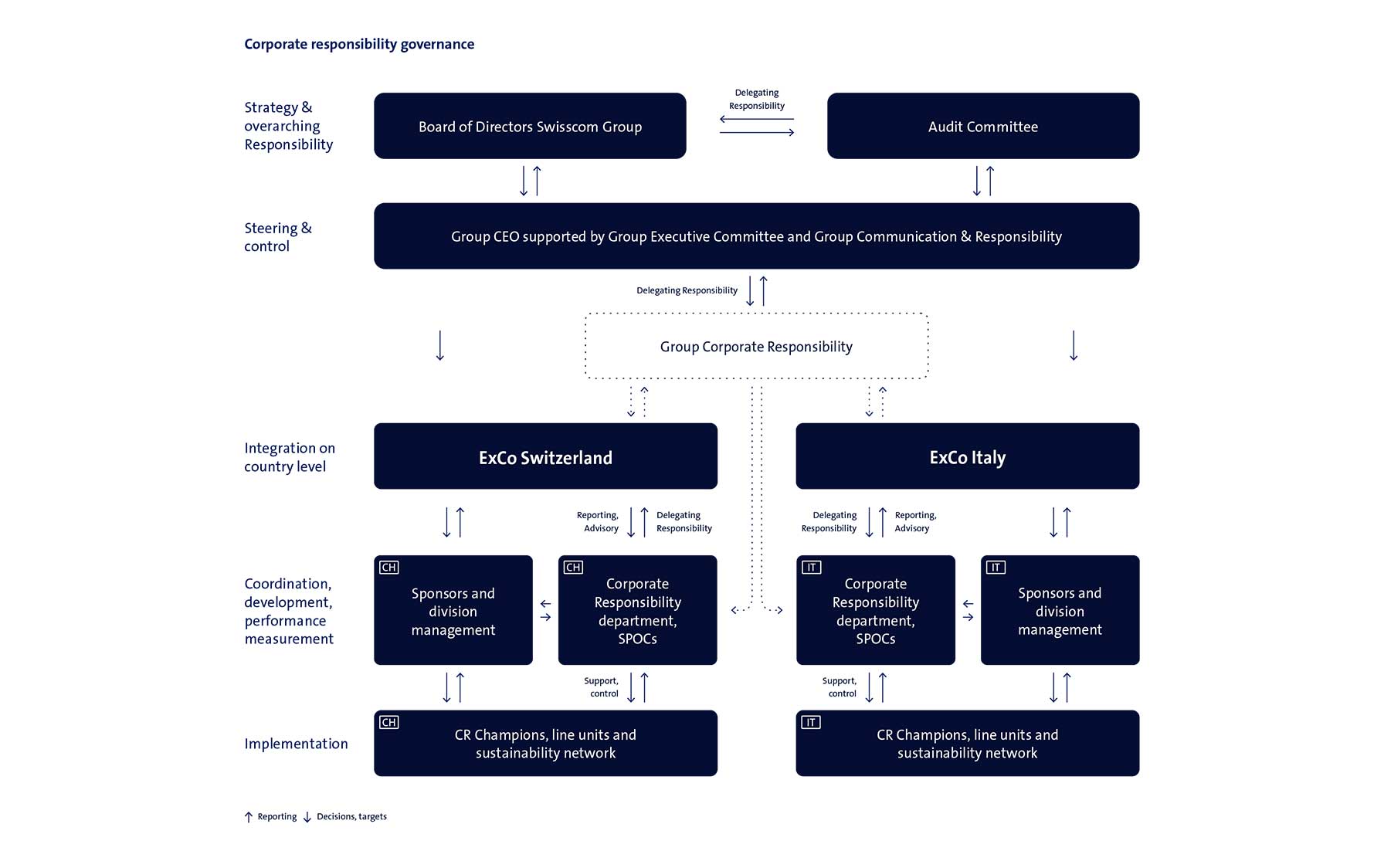
Organisation and responsibility
Board of Directors
The Board of Directors approves the Group Sustainability Strategy and the material non-financial matters for the Group at the Group CEO’s request. It monitors the implementation of measures regarding material impacts, risks and opportunities and issues the supply chain policy for conflict minerals and suspected child labour in products and services. In December each year, the Board of Directors determines the targets and key performance indicators (KPIs) of the Swisscom Group for the coming year. It receives information on progress in implementation of the Sustainability Strategy through the quarterly group management report as well as orally in the Board meeting in December. The Board of Directors submits the Annual Report to the General Meeting for approval.
The Board of Directors conducts a thorough examination of important issues through its committees. The Board of Directors has delegated certain sustainability issues to the Audit Committee.
The Audit Committee
The Audit Committee is made up of four independent members and handles issues relating to financial and non-financial management and reporting, assurance (risk management, internal control system of financial reporting, compliance including data protection, internal audit), security and external audits. The Committee takes positions on issues within the remit of the Board of Directors and makes final decisions on matters for which it has the necessary authority. In particular, it monitors implementation of strategies defined for material sustainability issues and evaluates the effectiveness of the defined measures (including monitoring of KPIs), decides which sustainability reporting regulations are applicable to the Group, decides on the audit of sustainability reporting, including selecting and instructing an auditor, structures internal and external reporting around key sustainability issues, designs and monitors the internal control system to ensure the reliability of sustainability data and reporting, and monitors compliance with due diligence obligations in relation to people and the environment (including the supply chain policy). The Audit Committee receives information on the status of the most important KPIs in the context of the quarterly group management report and discusses overall sustainability issues in three of its five annual meetings. Details of the roles and responsibilities are set out in the Organisational Regulation and annex 1.2 ‘Audit Committee regulations’.
CEO of Swisscom Group
The Board of Directors has delegated responsibility for implementing the Group Sustainability Strategy to the Group CEO, who can in turn delegate competencies to subordinate units. The Group CEO submits the Group Sustainability Strategy to the Board of Directors for approval and reports back twice a year to the Board of Directors and the Audit Committee on progress towards achievement of the goals.
The Group CEO, supported by the other members of the Group Executive Committee and the Head of Group Communications & Corporate Responsibility, defines the targets and measures for implementation of the Group Sustainability Strategy for the countries’ Executive Committees of Switzerland and Italy. At least twice a year, the Group Executive Committee discusses ongoing implementation of the defined measures. In November each year, the Group CEO adopts the roadmap and sub-targets (benchmarks) for the coming year.
The Ethics Working Group addresses corporate ethics issues as required. It comprises the Group CEO, the Head of Group Human Resources, and the Head of Group Communications & Corporate Responsibility, who bears individual responsibility for ethics.
Group Communications & Corporate Responsibility
Group Communications & Responsibility (GCR) oversees communications and corporate responsibility at the Group level. The Head of GCR is guest at Group Executive Committee meetings and manages communications and corporate responsibility for both Switzerland and the Group as a whole. GCR includes the Group Corporate Responsibility team, which is responsible for coordinating the sustainability agenda under the lead of the Head of Sustainability. As a Group function, the division provides expertise to enable decision-making and supports the Group CEO, Group Executive Committee, Board of Directors and subsidiaries in matters relating to sustainable development. This includes the development and implementation of the Group Sustainability Strategy on material impacts, risks and opportunities, including target setting, measures and involvement of stakeholders. Group Corporate Responsibility reports regularly to the Board of Directors, Group Executive Committee and the countries’ Executive Committees of Switzerland and Italy. It oversees corporate responsibility for both Switzerland and the Group as a whole.
Country Executive Committees (Switzerland and Italy)
Each country has a Country Executive Committee and its members are sponsors for the strategic action areas of their divisions. Together with division management, they are responsible for implementing the Group Sustainability Strategy in the line units. This ensures that sustainability action areas are binding and embedded in the company.
Roles of the Country Executive Committees Members
The members of the Country Executive Committees are the sponsors of the strategic activities of their divisions. Alongside their Division Managers, they are responsible for implementing the sustainability strategy in the respective lines of business.
| Executive Committee members Switzerland | Chief Financial Officer:
Eugen Stermetz |
|---|---|
| Commitment for the planet (E) | Mobility and property issues, climate risks and climate protection, water, biodiversity, forest, waste |
| Commitment for our communities (S) | |
| Commitment as a responsible leader (G) | Supply chain, human rights and child protection, Sustainability reporting |
| Executive Committee members Switzerland | Chief People Officer:
Klementina Pejic |
|---|---|
| Commitment for the planet (E) | Employee mobility, commuting,
business trips |
| Commitment for our communities (S) | Employees (labor management,
health and safety), employer attractiveness, employee incentives, talent development, diversity, inclusion and equal opportunities |
| Commitment as a responsible leader (G) |
| Executive Committee members Switzerland | Head of Business Customers:
Thomas Wettstein (a.i.) |
|---|---|
| Commitment for the planet (E) | Business customers sustainable portfolio, avoided emissions |
| Commitment for our communities (S) | |
| Commitment as a responsible leader (G) |
| Executive Committee members Switzerland | Head of Residential Customers:
Dirk Wierzbitzki |
|---|---|
| Commitment for the planet (E) | Residential customers sustainable portfolio, avoided emissions, circular economy, product safety |
| Commitment for our communities (S) | Residential customers, accessibility |
| Commitment as a responsible leader (G) |
| Executive Committee members Switzerland | Head of Group Security & Corporate Affairs:
Martin Vögeli |
|---|---|
| Commitment for the planet (E) | |
| Commitment for our communities (S) | Data privacy |
| Commitment as a responsible leader (G) | Compliance, risk management, governance, IT security, data security |
| Executive Committee members Switzerland | Chief Group Communications & Corporate Responsibility Officer:
Myriam Käser |
|---|---|
| Commitment for the planet (E) | Climate protection and BVCM |
| Commitment for our communities (S) | Digital inclusion and education, youth media protection, social engagement |
| Commitment as a responsible leader (G) | Corporate ethics, Corporate Responsibility governance |
| Executive Committee members Switzerland | Head of Group Strategy & Business Development:
Isa Mueller-Wegner |
|---|---|
| Commitment for the planet (E) | Innovation, venture |
| Commitment for our communities (S) | Innovation, venture |
| Commitment as a responsible leader (G) | Strategy, innovation |
| Executive Committee members Switzerland | Chief Technology and Information Officer:
Mark Düsener |
|---|---|
| Commitment for the planet (E) | Network-related issues, energy efficiency |
| Commitment for our communities (S) | Network expansion, basic service provision |
| Commitment as a responsible leader (G) |
The Executive Committee of Swisscom Switzerland has the following controlling instruments:
- Periodic reporting from the GCR division on main events
- Half-year report containing the principle KPIs relating to the sustainability strategy’s major themes
- Quarterly report on Risk Management and the achievement of sustainability goals
- Half-year status report in the divisional management bodies on the status of the segment’s roadmap.
| Executive Committee members Fastweb + Vodafone | Chief Financial Officer:
Peter Grueter |
|---|---|
| Commitment for the planet (E) | |
| Commitment for our communities (S) | |
| Commitment as a responsible leader (G) | Supply chain, human rights and child protection |
| Executive Committee members Fastweb + Vodafone | Chief People Officer:
Silvia Cassano |
|---|---|
| Commitment for the planet (E) | Mobility and Property issues, Employee mobility, commuting, business trips |
| Commitment for our communities (S) | Employees (labor management, health and safety), employees attractiveness, employees incentives, talent development, diversity, equity and equal opportunities |
| Commitment as a responsible leader (G) |
| Executive Committee members Fastweb + Vodafone | Chief B2B Officer:
Augusto Di Genova |
|---|---|
| Commitment for the planet (E) | Business customers sustainable portfolio, avoided emissions |
| Commitment for our communities (S) | |
| Commitment as a responsible leader (G) |
| Executive Committee members Fastweb + Vodafone | Chief B2C Commercial Officer:
Federico Negri |
|---|---|
| Commitment for the planet (E) | Avoided emissions |
| Commitment for our communities (S) | Residential customers, accessibility |
| Commitment as a responsible leader (G) |
| Executive Committee members Fastweb + Vodafone | Chief Wholesale Officer:
Fabrizio Casati |
|---|---|
| Commitment for the planet (E) | Wholesales customers sustainable portfolio |
| Commitment for our communities (S) | |
| Commitment as a responsible leader (G) |
| Executive Committee members Fastweb + Vodafone | Chief Legal & Regulatory Officer:
Elenia Cerchi |
|---|---|
| Commitment for the planet (E) | |
| Commitment for our communities (S) | Data Privacy |
| Commitment as a responsible leader (G) | Compliance, governance |
| Executive Committee members Fastweb + Vodafone | Chief Communication & Sustainability Officer:
Lisa Di Feliciantonio |
|---|---|
| Commitment for the planet (E) | Climate risks and protection, water, biodiversity, forest, waste, ESG reporting |
| Commitment for our communities (S) | Digital inclusion and education, gender violence, youth media protection |
| Commitment as a responsible leader (G) | Sustainability Reporting |
| Executive Committee members Fastweb + Vodafone | Chief Brand & B2C Marketing Officer:
Anita Carra |
|---|---|
| Commitment for the planet (E) | Residential customers sustainable portfolio, product safety |
| Commitment for our communities (S) | |
| Commitment as a responsible leader (G) |
| Executive Committee members Fastweb + Vodafone | Chief Strategy & Transformation Officer:
Alessandro Magnino |
|---|---|
| Commitment for the planet (E) | Circular Economy, product safety, Innovation, venture |
| Commitment for our communities (S) | Venture |
| Commitment as a responsible leader (G) | Strategy, innovation, Risk management |
| Executive Committee members Fastweb + Vodafone | Chief Technology & Security Officer:
Max Gasparroni |
|---|---|
| Commitment for the planet (E) | Network related issues, energy efficiency |
| Commitment for our communities (S) | Network expansion, basic service provision |
| Commitment as a responsible leader (G) | Data security |
| Executive Committee members Fastweb + Vodafone | Chief IT Officer:
John de Keijzer |
|---|---|
| Commitment for the planet (E) | |
| Commitment for our communities (S) | |
| Commitment as a responsible leader (G) | IT Security |
The Executive Committee of Fastweb + Vodafone has the following controlling instruments:
- Periodic reporting from the Sustainability division on main events.
- Half-year report containing the principle KPIs relating to the sustainability strategy’s major themes
Corporate Responsibility departments (Switzerland and Italy)
Switzerland and Italy both have a Corporate Responsibility department at the country level to ensure the implementation of the Group Sustainability Strategy and appropriate performance measurement, and provide expertise to enable subsidiaries and business units to meet sustainability targets. For each business unit of Swisscom (e.g. B2C), single points of contact (SPOCs) are nominated; these are the contacts for division management and the CR Champions across business units in coordinating the sustainability agenda. The Corporate Responsibility departments in Switzerland and Italy collaborate closely on sustainability issues to leverage synergies.
SPOCs, CR Champions, line units and the Sustainability Network
Each business unit has CR Champions who share responsibility for operational implementation of measures with line units (related to individual products or services, for instance) and report to the sponsors and SPOCs of the Corporate Responsibility teams on the progress of implementation. The Corporate Responsibility departments sponsor the Sustainability Network which is open to all employees, with members meeting throughout the year to exchange information and raise awareness of sustainability issues in ‘green lunches’ and other formats.
Sustainability-related incentive schemes
The members of the Group Executive Board are entitled to a variable performance-related salary component, which includes sustainability indicators based on employee satisfaction, diversity, CO2 reduction and energy efficiency improvements. Further details on Swisscom’s incentive scheme and sustainability-related performance metrics are available in the Renumeration Report.
Risk management and internal controls
The DMA process included the application of the ERM framework to allow comparison of ESG risks with other key risks of the Group, with the results reviewed by Enterprise Risk Management. While the experts responsible for critical elements at Swisscom (first line) are generally responsible for managing risks in their division, overarching keys risks are reported to Enterprise Risk Management. Fastweb + Vodafone reports regularly to Swisscom, with material risks included in its quarterly and annual risk reports to the Internal Control Committee and the Board of Directors. At the Group level, risks can be proactively included in the quarterly risk reports to the Board of Directors.
Swisscom uses the dual control principle, plausibility and completeness checks, and other methods across the Group to mitigate the risk of misstatement. Furthermore, review controls are carried out across different levels of the Group. Swisscom aims to holistically embed ESG into the Group’s Internal Control System forthcoming.